Last Updated on June 24, 2026
Google is the world’s most popular search engine, fielding at least 8.5 billion searches per day. That’s 8.5 billion reasons nonprofits should take advantage of the Google Ad Grant program, which gives $10,000 worth of ad credits to eligible organizations every month to create ads on Google.
Of course, running those campaigns isn’t as simple as flipping a switch. Ads need regular maintenance, performance monitoring, and most importantly, compliance with Google’s requirements. This is exactly where the right Google Ad Grant agency can take a lot off your plate!
But what exactly makes for a good Google Ad Grant agency?
A strong agency has Ad Grant specialists who have mastered the program’s rules, application, and account reactivation process, campaign creation, and ongoing Ad Grant account management techniques. Being a certified Google Partner (like Getting Attention) adds another layer of credibility because it means the agency meets Google’s standards for performance, has certified strategists on staff, and manages accounts at a level that consistently supports growth.
To make the process of choosing the right Grant agency easier, this guide will discuss the following topics:
- What is a Google Grant Agency?
- What does Google Ad Grant management entail?
- What is a Google Partner?
- What are the benefits of hiring a professional for Google Ad Grant management?
- What are the steps to hiring a Google Ad Grant Agency?
- What are the different types of Google Ad Grant Agencies?
- Why nonprofits switch Google Ad Grant agencies (based on what we’ve seen firsthand)
- Is Getting Attention the right Google Ad Grant partner for your nonprofit?
- Why Getting Attention works for nonprofits that want better Ad Grant results
- Next steps for your Google Ad Grant strategy
At Getting Attention, we’ve helped hundreds of nonprofits improve and rebuild their Google Ad Grant accounts over the years, which gives us a useful perspective on what to look for in an agency. Let’s get started so you can partner with the right Google Ad Grant manager!

What is a Google Grant agency?
A Google Ad Grant agency is composed of Ad Grant specialists who handle the aspects of the Google Ad Grant program that most nonprofits don’t have time to figure out themselves. They manage accounts with one main objective: turning $10,000 worth of ad credits into measurable outcomes, like volunteer sign-ups, donations, increased awareness, better donor engagement, and more.
In day-to-day terms, a professional agency will handle multiple aspects of Google Grant management, such as:
- Eligibility confirmation: Agencies understand the eligibility requirements in detail and can quickly assess whether your nonprofit qualifies and what might need to be fixed.
- Program applications: A Google Ad Grants professional can walk you through every step of the application, help you follow up with Google Support as needed, and give you a higher chance of approval. (Fun fact: every Ad Grant application supported by Getting Attention has been successfully approved!)
- Keyword research: Agencies conduct research on intent-driven keywords, helping your ads appear in searches from people actively looking for what your nonprofit offers.
- Ad creation: Strong agencies use keyword data and ad assets to build ads that align with search intent and encourage meaningful conversions (e.g., donations, increased donor engagement, activity signups) – not just irrelevant traffic.
- Compliance with the program’s rules: Google’s requirements are specific and tend to change over time. A Grant manager keeps your account in line with those rules so you don’t run into avoidable issues!
- Account reactivation if needed: Failing to comply with the program’s rules (or automated enforcement from an overzealous Google policy bot – if you’ve been in the trenches, we salute you) can cause your account to be suspended. If this happens, a Grant agency will get in touch with Google on your behalf and help you reactivate your account as quickly as possible.
- Ongoing Google Ad Grant account optimization: Strong agencies treat optimization as an ongoing process, regularly testing, refining, and restructuring campaigns and ad copy so your account continues to improve instead of staying static.
Beyond daily Ad Grant management, the ideal agency helps nonprofits build awareness for their cause and create high-converting campaigns that are meaningful to the organization’s work.
Some agencies have earned Google Partner status, which is basically Google’s way of recognizing consistent, high-quality work. Newer agencies can still be worth considering, but this designation is a helpful signal when you’re narrowing your list!
What does Google Ad Grant management entail?
We listed a general overview of what an agency manages on a day-to-day basis, but it would help to go into deeper detail. Let’s talk about what Grant management work looks like in practice.
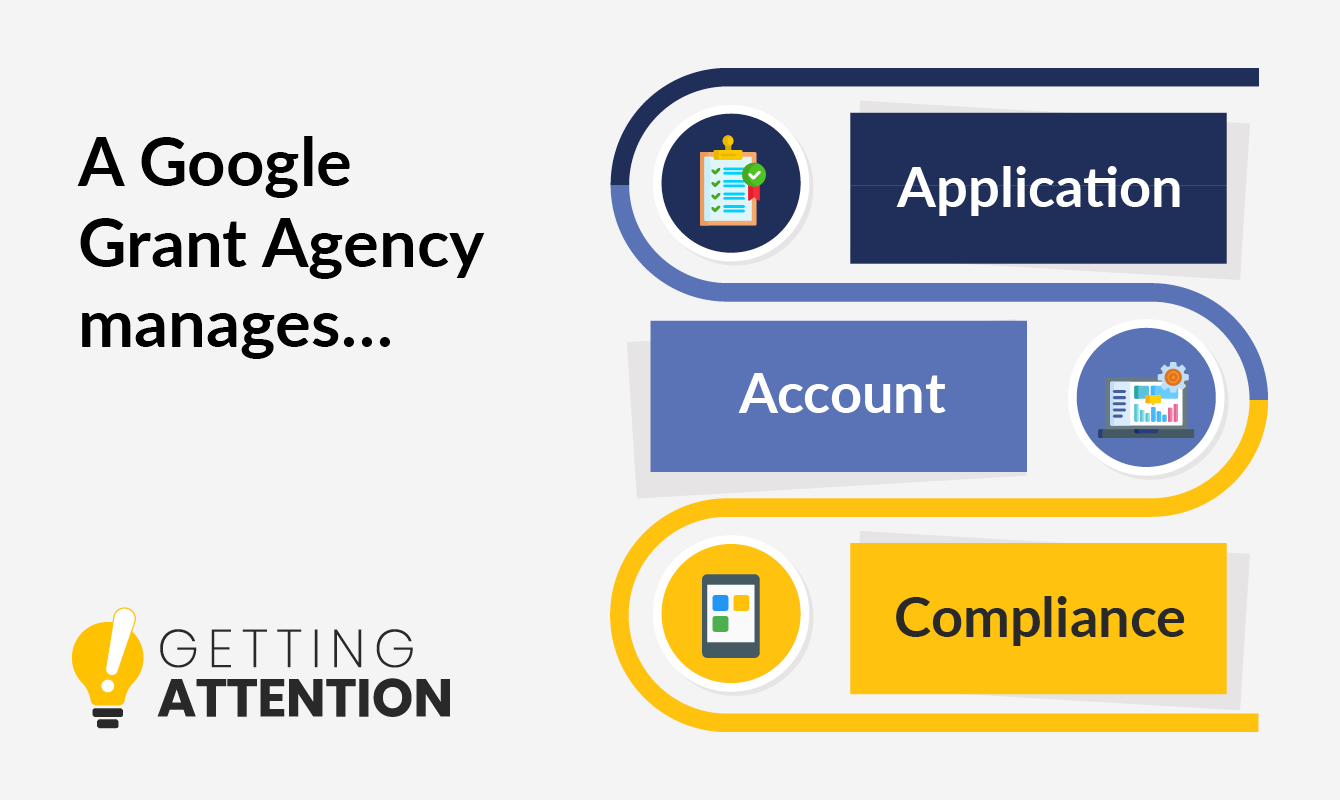
Google Ad Grant Application
If you don’t already have your account set up, a Google Grant agency can help you get started by checking your eligibility and guiding you through the application process. They can support you in completing these application requirements:
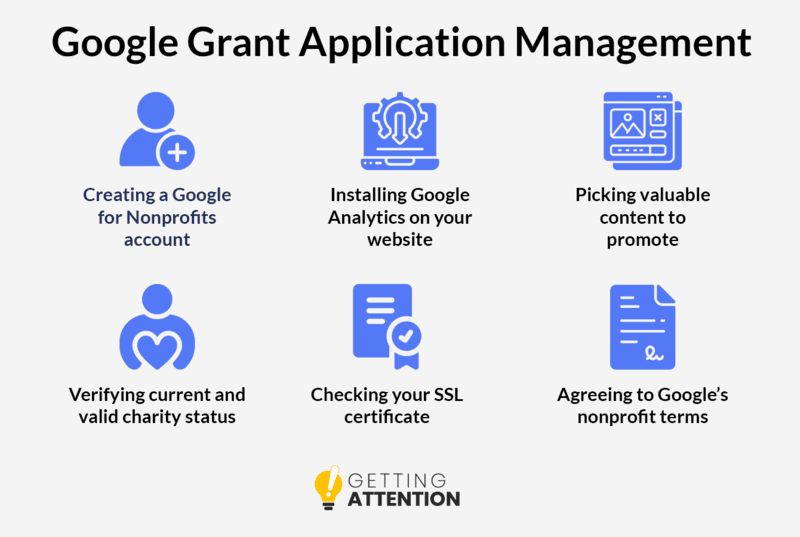
- Verifying your current and valid charity status: Before applying, your organization needs a valid 501(c)(3) status if you’re based in the U.S. Agencies help verify that everything is properly registered and ready for approval.
- Checking that you have a valid SSL certificate: You’ll need a Secure Sockets Layer (SSL) certificate, which is what allows your website to load securely with “https” instead of “http.” It basically encrypts data and signals that your site is safe to use. A Google Grant agency can check if you have one in place and even guide you through getting one if needed.
- Creating a Google for Nonprofits (G4N) account: Agencies help make sure you meet the requirements and get verified through Google’s verification partner, Goodstack. Once your G4N account (this is separate from a standard Google account!) is approved, you’ll gain access to the Ad Grant along with tools like Google Workspace for Nonprofits and the YouTube Nonprofit Program.
- Installing Google Analytics on your website: Google Analytics is a program requirement and the foundation for tracking performance, helping you understand what users do after they click your ads. Both you and your Ad Grant manager can use this to optimize your website and ad campaigns for better performance.
- Picking valuable content to promote: The right agency will know the difference between driving traffic for the sake of it and bringing relevant, convertible traffic to your site. They help you decide which actions to prioritize, then choose the pages on your site that are most likely to lead to those outcomes. For example, if you want to boost volunteer registrations, they might suggest promoting your volunteer information and registration page.
If your nonprofit meets the eligibility requirements and your website is in good shape, you’re already in a strong position to get approved! The role of an agency is to catch any gaps early and keep the application process moving.
Google Ad Grant Account Management
Search ads are often one of the more effective paid channels for nonprofits as they have the highest return on investment (ROI), so the real value of the Ad Grant comes from how well it’s managed over time. To help you get more out of your $10,000 each month and strengthen your marketing, agencies usually handle things like:
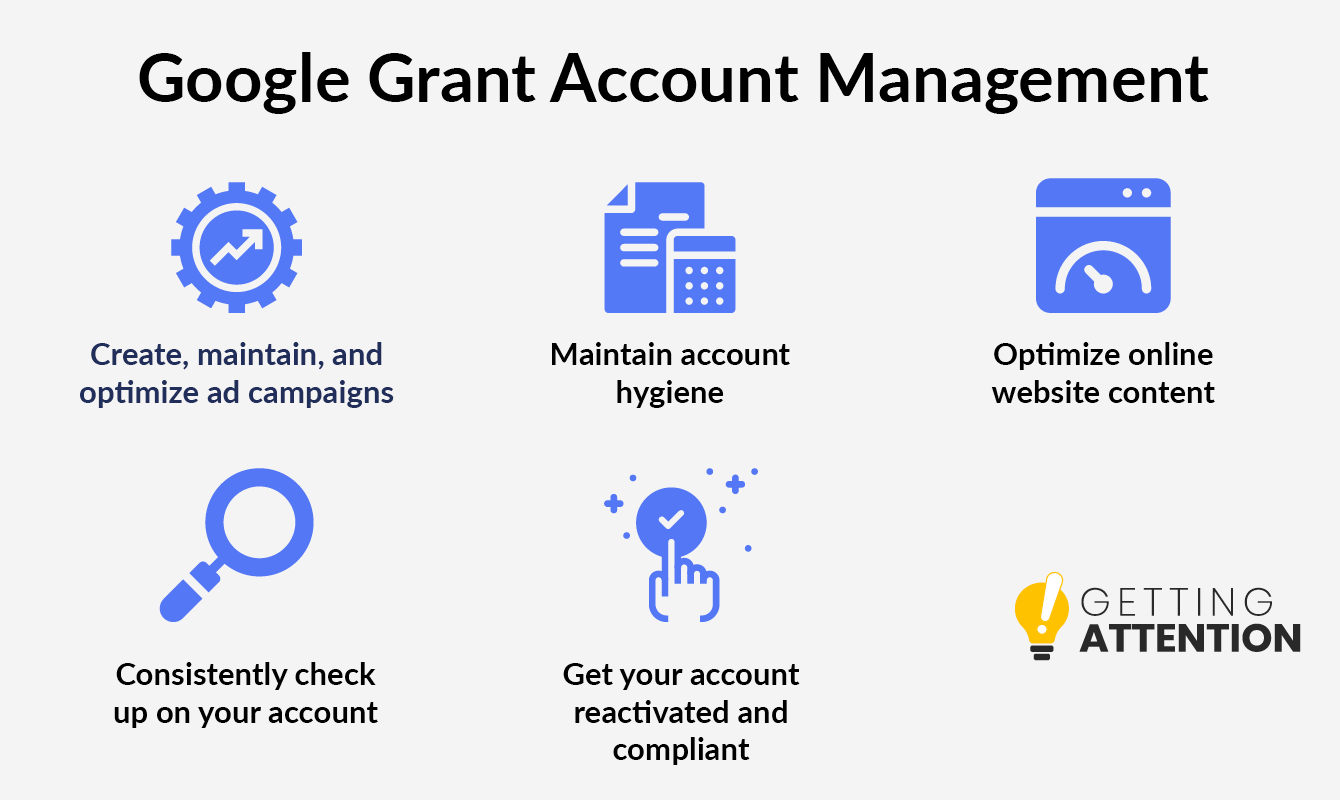
- Create, maintain, and optimize ad campaigns: Most effective accounts run several campaigns simultaneously, each designed to support a specific objective. Agencies track performance, share regular updates, and improve ads to improve results over time. They can even provide reports with data from Google Analytics and Google Tag Manager so that you can get a sense of your goal progress in real time.
- Maintain account hygiene: Agencies audit your account regularly to remove low-quality or outdated keywords, pause ineffective ads, update targeting, and streamline campaign structure. This helps improve performance and make better use of your Grant budget.
- Optimize online website content: As your Google Grants account matures, your content needs to keep up. Agencies research keywords tied to your mission and use those insights to suggest improvements to your web pages to better match what people are searching for. This, in turn, helps improve both traffic quality and conversions. Some agencies, like Getting Attention, also offer content writing or landing page creation services alongside Grant management to help close that gap more effectively.
- Consistently check up on your account: Maintaining your account is an ongoing process. Agencies review your account on a regular basis, analyzing performance data, identifying trends, and making updates to make sure your campaigns are contributing to your core goals.
- Get your account reactivated and compliant: Managing a Google Ad Grants account can be confusing, and account suspensions happen more often than you’d like. If your account is suspended, partnering with a professional who knows the ins and outs of Google Grant compliance is your smartest option.
When your team is stretched across multiple priorities, the Ad Grant can become harder to manage effectively. A Google Ad Grant manager knows how to use it to drive conversions and see measurable results for your organization – all without adding more to your plate.
Google Ad Grant Compliance
One of the most important roles of a Google Ad Grant agency is to keep nonprofits’ accounts in compliance with the program’s guidelines. Google revisits and updates its policies from time to time, so the official compliance page will be your best bet if you want to check up on the rules.
Agencies handle that by staying on top of the details, including:
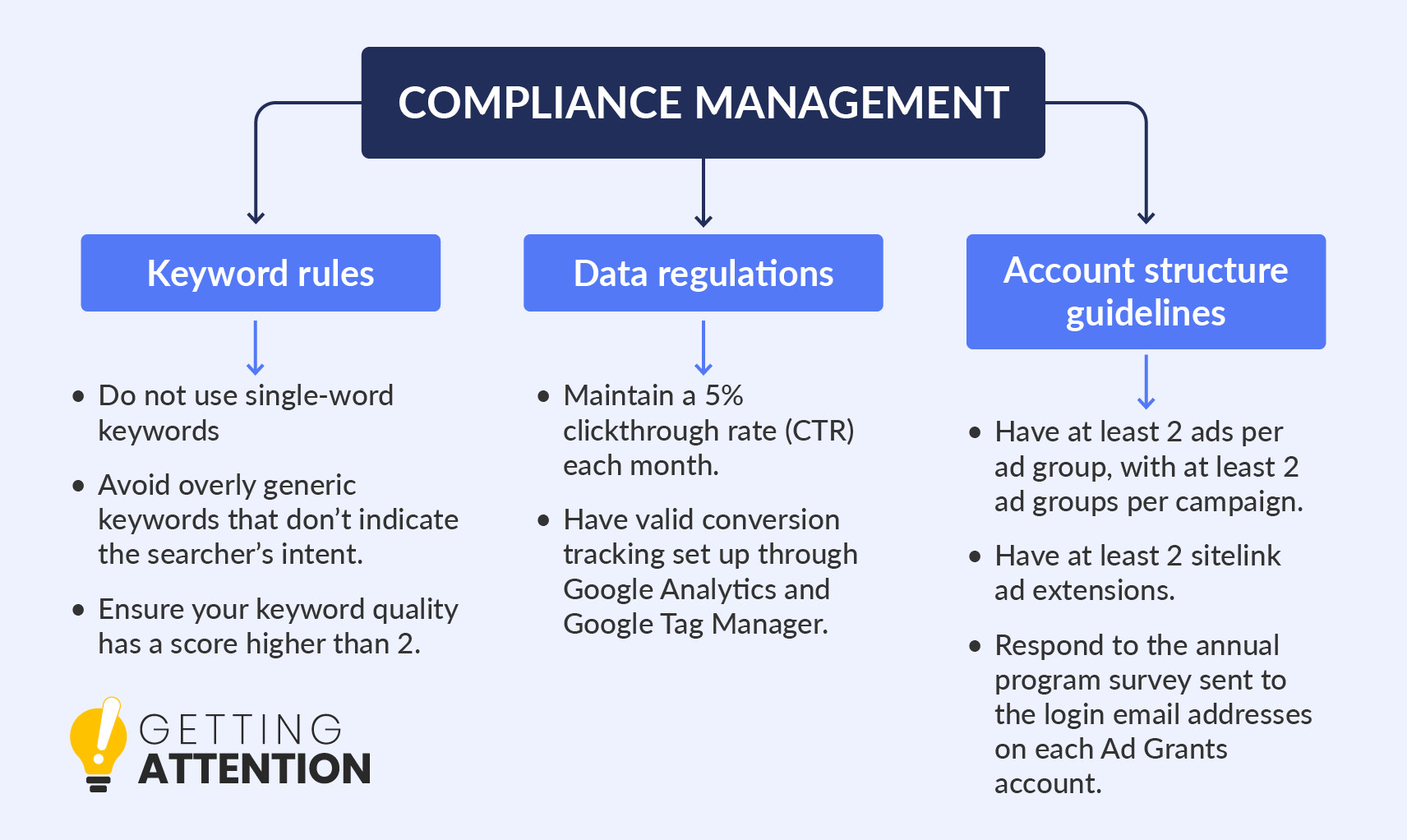
- Keyword rules: Google requires advertisers to avoid single-word and overly generic keywords (with some exceptions) that don’t reflect user intent. Agencies manage this by selecting more targeted keywords and double-checking that they meet the minimum quality score requirements (score must be higher than 2).
- Data regulations: A Google Grant manager tracks your click-through rate to make sure it stays above the 5% requirement. They also handle conversion tracking and keep an eye on performance through Google Analytics and Google Tag Manager, so your account continues generating the required one meaningful conversion each month.
- Account structure guidelines: An agency will make sure your account follows the right structure, including (1) running at least 2 ads per group, (2) using at least 2 sitelink assets, and (3) responding to the annual program survey.
Bottom line: A Google Grant agency will keep your Ad Grant account in check and fully compliant, even as Google updates its rules. Make sure the Google Ad Grant manager you partner with is able to support more complex strategies and changing priorities.
What is a Google Partner?
Google Partners are agencies that Google has recognized for consistently managing high-quality ad campaigns. While Google Partners aren’t run by Google itself, they do meet specific performance and certification standards and receive additional support to help maintain strong results for their clients.
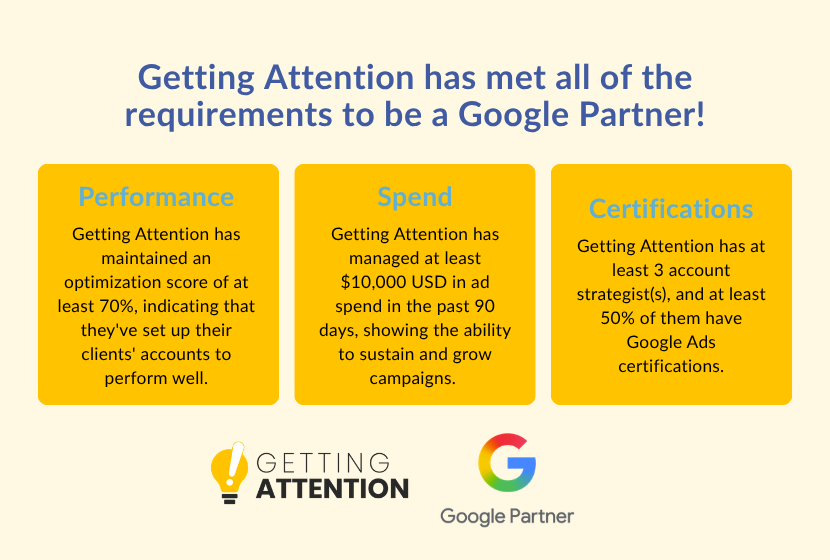
For example, Getting Attention has met these Google Partner performance requirements:
- Performance: Keeps account optimization scores at 70% or higher, proving that campaigns are actively managed and improving.
- Spend: Manages at least $10,000 in ad spend over a 90-day period, showing the ability to sustain and grow campaigns.
- Certifications: Has at least 3 account strategists, with at least 50% holding Google Ads certifications to demonstrate platform expertise.
Most agencies will mention their Google Partner status on their website. But if you want to double-check or narrow your search, you can use Google’s Partner Directory to filter by location, certification level, or even look up a specific agency.
What are the benefits of hiring a professional for Google Ad Grant management?
The Google Ad Grant has a lot of potential on its own, but its performance ultimately depends on how it’s managed. With the right agency, your campaigns are more likely to reach the right audience and drive meaningful actions.
These are the main benefits you can expect when you partner with a competent Ad Grant agency:
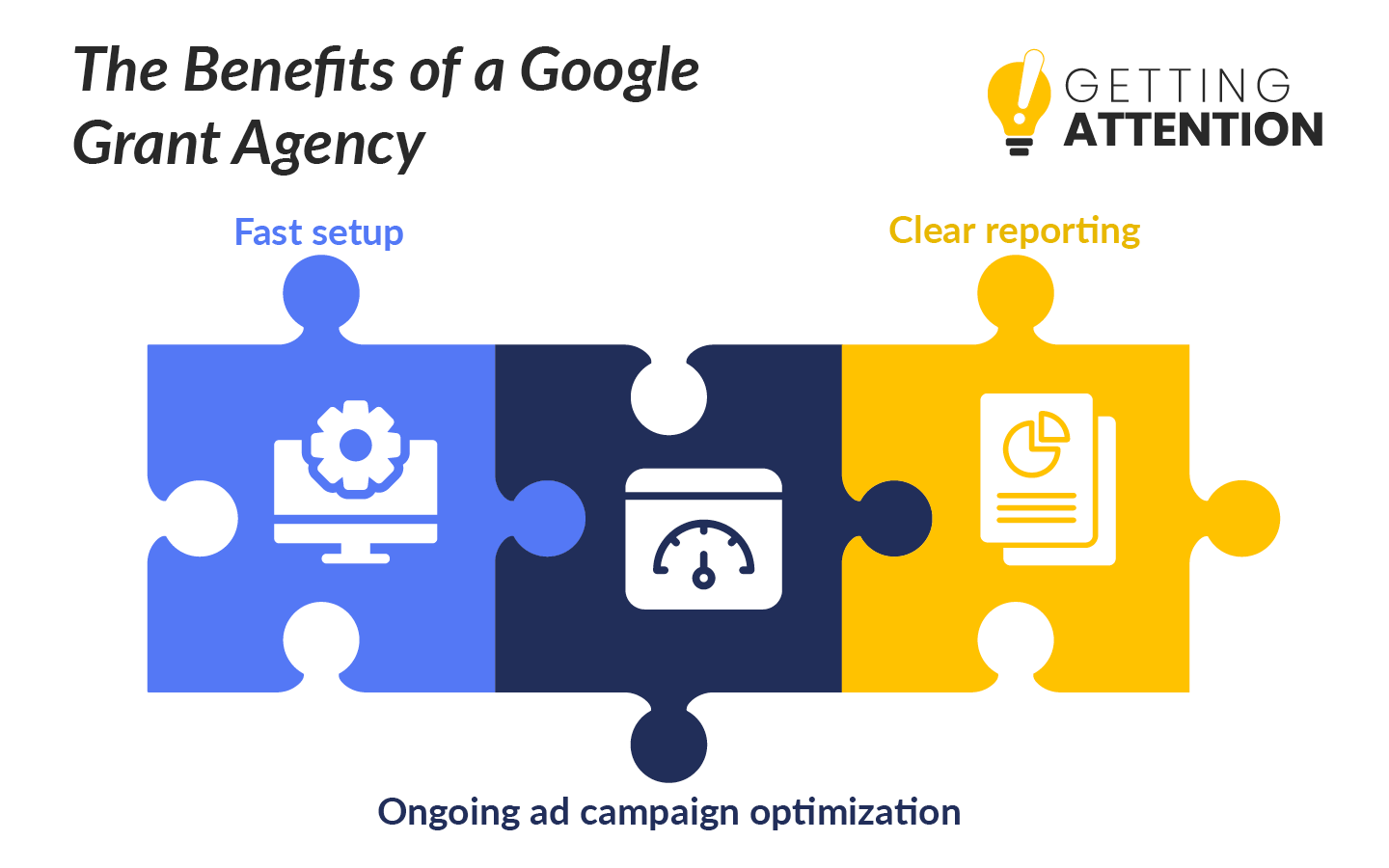
- Fast setup: An agency will walk you through the entire application process for the Ad Grant program and get your ads up and running as soon as your account is approved. A typical Getting Attention client has ads live within a week of starting to work with us.
- Ongoing optimization: Once your ads are live, agencies regularly review performance, spot areas for improvement, and make updates so your campaigns keep getting better over time.
- Provide regular updates and reporting: Agencies like Getting Attention provide monthly reporting on core metrics like traffic, conversions, and campaign performance. More importantly, we explain what those numbers mean and outline the next steps to make informed decisions.
These professionals have in-depth knowledge of the program’s requirements, features, and tools, so you can spend your time focusing on other areas of your nonprofit. Partnering with a Google Ad Grant agency can be incredibly beneficial, as long as you spend time choosing the right one for your team!
What are the steps to hiring a Google Ad Grant agency?
Working with a certified, knowledgeable agency is what turns the Ad Grant into a powerful marketing tool. To find the right fit for your organization, we recommend approaching your search in three stages:
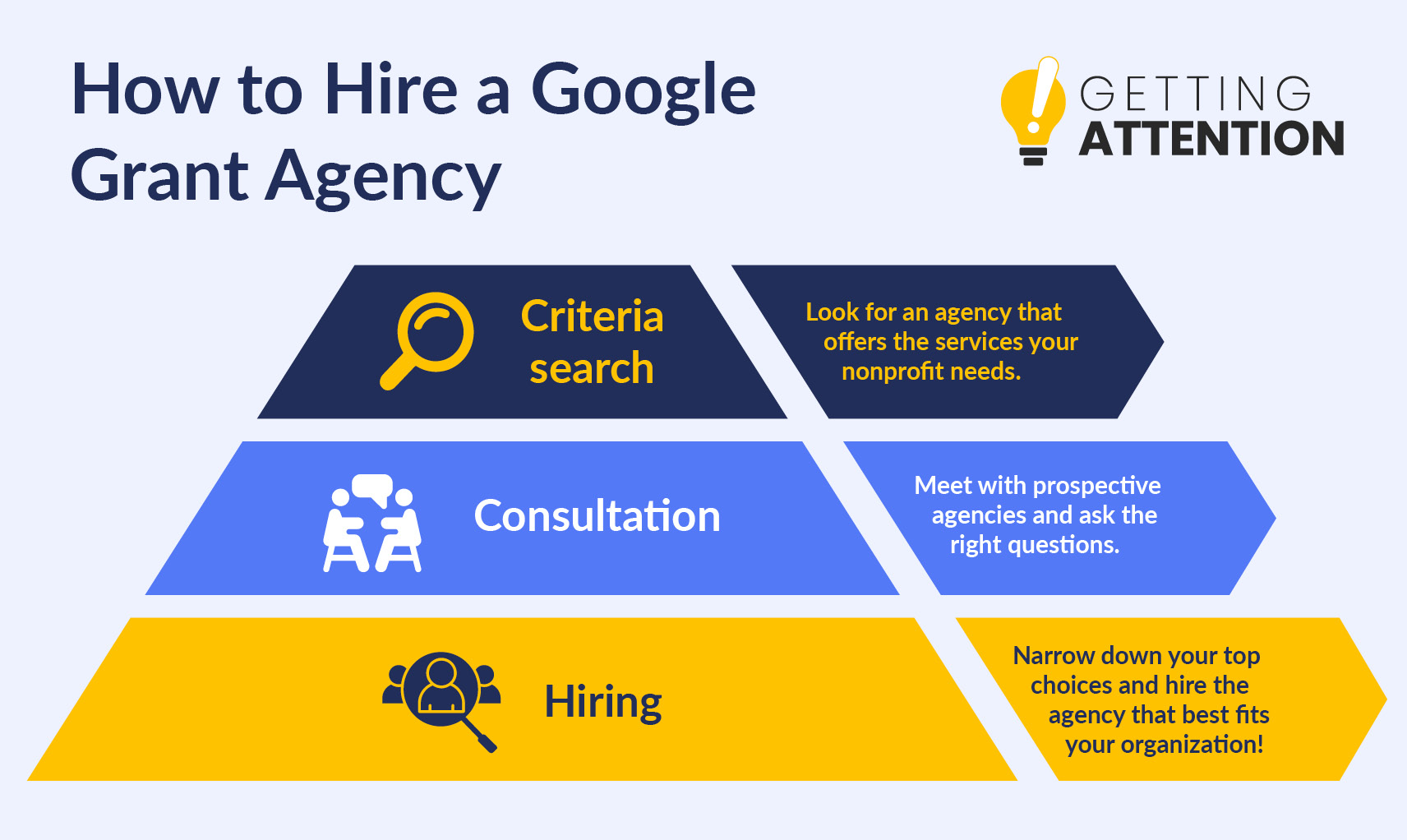
- Criteria search: Look for agencies that check your non-negotiables, like Ad Grant specialization, a fair pricing model that fits your budget, and credentials such as Google Partner status. Then, dig into their website to see how they approach their work, what types of organizations they work with, and what kind of results they’ve delivered for previous or current clients.
- Consultation: Talk to a shortlist of agencies to get a better sense of their approach. It helps to go in with a few questions, especially around certifications, communication, reporting, and how they handle requests outside their standard scope. Many agencies offer free consultations, so take advantage of these to compare options and find the best fit for your organization!
- Hiring: Once you’ve shortlisted a few agencies, compare them based on how well they meet your priorities, including communication style, level of support, reporting clarity, and overall approach. This is also the stage to clarify expectations around timelines, deliverables, and collaboration. From there, choose the agency that best fits both your goals and how your team prefers to work.
Above all else, prioritize an agency’s Ad Grant program knowledge, service offerings, and professionalism. When those are in place, the agency tends to feel like part of your team rather than someone working on the sidelines.
What are the different types of Google Ad Grant Agencies?
Most agencies fall into a few recognizable buckets, and each one comes with its own set of tradeoffs. There’s no universally “best” option – just the one that lines up with your team, goals, priorities, and how involved you want to be.
Let’s talk about it!
1. Large nonprofit-focused firms
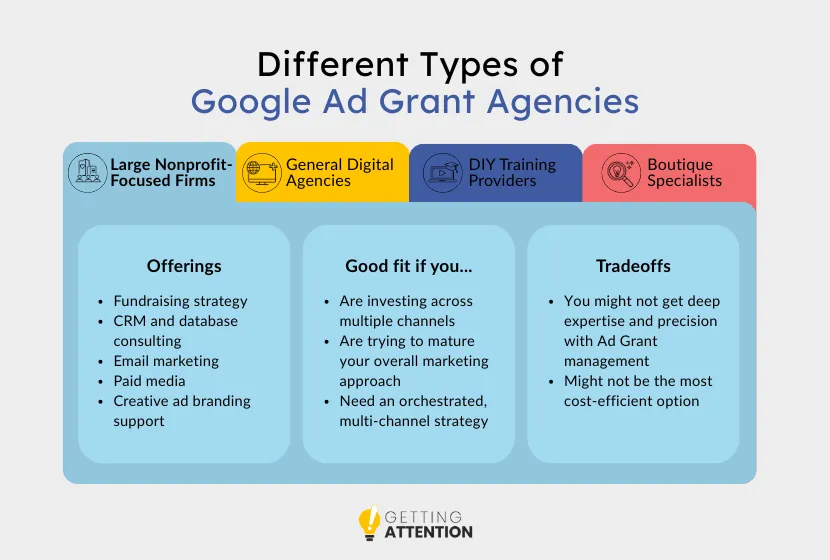
Large nonprofit-focused agencies position themselves as full-service partners. They usually offer a wide range of services to nonprofit organizations, including fundraising strategy, CRM and database consulting, email marketing, paid media, and sometimes even creative and branding support. From a structural standpoint, your Google Ad Grant account becomes one component within a much larger ecosystem of marketing activity.
What do large nonprofit-focused firms offer?
The primary advantage here is integration. Instead of treating your Ad Grant campaigns as a standalone channel, these agencies look at how they fit into your broader donor journey. They may align your ads with seasonal campaigns, coordinate messaging with email appeals, and connect reporting back to your CRM.
You also gain access to a larger team, which can be helpful if your needs extend beyond paid search. There’s often a sense of strategic continuity across channels, which can be quite valuable for organizations trying to mature their overall marketing approach.
Where do large nonprofit-focused firms work best?
This model tends to work well for nonprofits that are already investing across multiple channels and need a partner to help orchestrate those efforts. If your team is thinking about long-term growth, multi-channel attribution, and a more advanced fundraising strategy, the added breadth can be quite useful.
What are the tradeoffs of working with large nonprofit-focused firms?
Since these firms are spread across multiple service areas, the Google Ad Grant may not receive the level of day-to-day attention required to fully maximize performance. Ad Grants are not passive channels, meaning they require ongoing iteration – especially within the constraints Google imposes.
There’s also the question of cost. You may find yourself paying for bundled services that go beyond what you actually need, particularly if your primary goal is to improve Ad Grant performance. You gain strategic breadth and integration, but you may sacrifice some depth and precision within the Ad Grant itself.
Large agencies also tend to cost more, which may put them out of reach for small or mid-sized nonprofits.
2. General digital agencies offering Ad Grants as an add-on
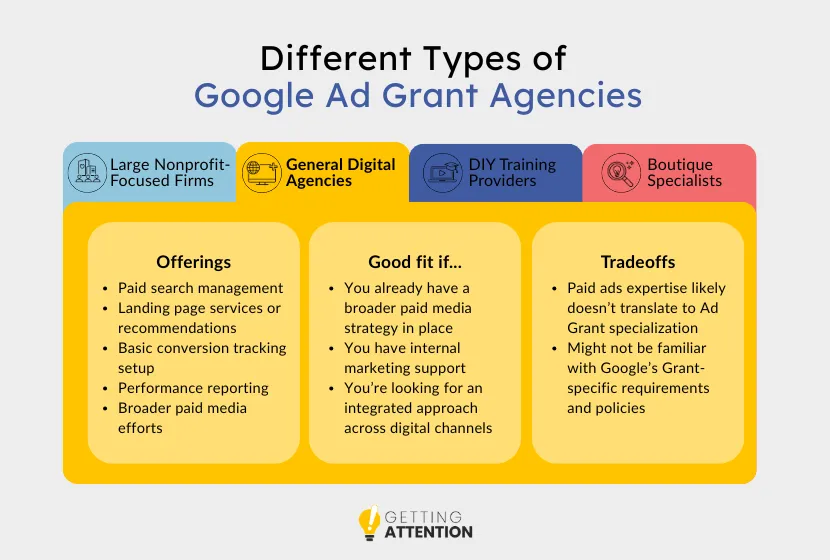
General digital agencies often come from a for-profit background and specialize in paid advertising across platforms like Google Ads, Meta, and other performance channels. In many cases, Google Ad Grants are offered as an additional service or a freebie rather than a core focus.
What do general digital agencies offer?
These agencies tend to be strong on the mechanics of paid search. They understand campaign structure, keyword match types, ad testing frameworks, and how to optimize for click-through rates and conversions within a standard Google Ads environment.
They also often bring experience with landing page services or recommendations, basic conversion tracking setup, and performance reporting. In some cases, they can support broader paid media efforts, like social ads or display campaigns, which can be useful if you’re looking for a more integrated approach across channels.
Where do general digital agencies work best?
General agencies are often a good fit for nonprofits that already have a broader paid media strategy in place. If you’re running paid campaigns outside of the Ad Grant, it can be helpful to have one team managing everything for consistency.
They’re also a good match for organizations with internal marketing support, where the agency can focus on execution while your team guides strategy, messaging, and priorities. Since these agencies are strongest in paid search mechanics, they tend to perform best when goals, conversion paths, and landing pages are already well-defined.
What are the tradeoffs of working with general digital agencies?
The main limitation (and it’s a doozy) is that Google Ad Grants operate under a different set of rules than standard Google Ads accounts. There are strict compliance requirements, including minimum performance thresholds, limitations on certain types of keywords, and ongoing eligibility checks that can affect your account’s status.
There’s also a strategic mismatch to consider. Commercial PPC strategies are built around revenue generation and often rely on tactics that don’t translate cleanly to nonprofit goals. Driving a purchase is fundamentally different from inspiring a donation or encouraging someone to engage with a mission-driven service.
One way to go about this limitation is to hire agencies like Getting Attention, which offers an integrated paid ads and Ad Grant management service. This way, you get a unified strategy across paid and Grant accounts, shared data insights, and more efficient use of budget and search visibility.
3. DIY training providers
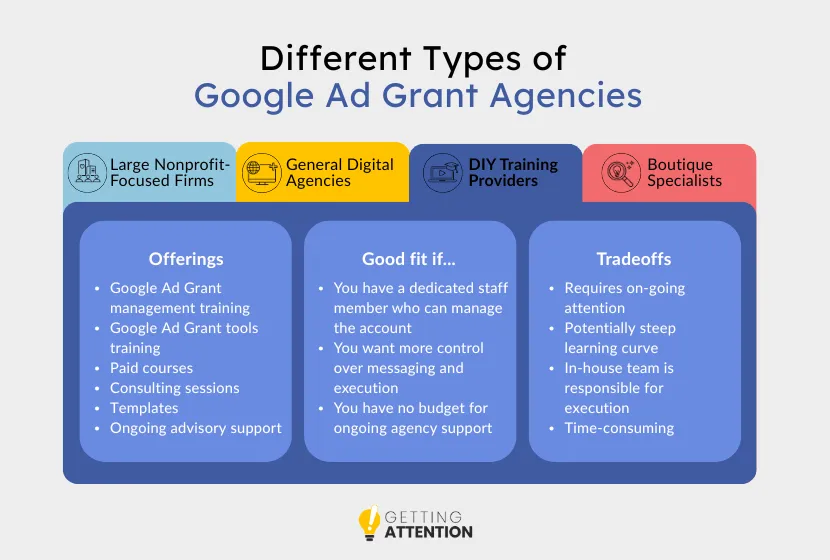
DIY training providers take a different approach entirely. Instead of managing your account, they teach your team how to manage it and provide training on how to use the tools needed to run the Google Ad Grant internally.
This can include courses, workshops, consulting sessions, templates, and ongoing advisory support.
What do DIY training providers offer?
The biggest benefit is capability building. Your team develops a working understanding of how the Grant operates, from compliance requirements to campaign setup to performance optimization. Over time, this can make you less reliant on external vendors and give you more direct control over your account.
If your nonprofit prefers hands-on management, we recommend exploring training providers like Digital Tabby or Whole Whale, who focus on empowering in-house teams!
Where do DIY training providers work best?
This model works best when you have a dedicated staff member who can consistently manage the account. And yes, we really do mean a full-time staff member who can own every piece of the process (not an intern or your one poor development lead who’s juggling ten things already). Managing the account doesn’t just mean setting it up – but actively monitoring, testing, and refining campaigns on a regular basis.
DIY training can also be a good fit if you want more control over messaging and execution, or if your budget doesn’t allow for ongoing agency support. It tends to work best for teams that are comfortable working with data, willing to learn the platform, and able to commit time each week to keep the account compliant and improving.
What are the tradeoffs of working with DIY training providers?
The challenge comes down to sustainability. Google Ad Grants require ongoing attention, and the learning curve can be steep, particularly for teams without prior experience in paid search. Even with strong training, your team is still responsible for execution. That includes keyword research, ad testing, performance analysis, and staying on top of policy updates.
There’s also the question of opportunity cost. Time spent managing the Ad Grant is time not spent on fundraising strategy, donor relationships, or program delivery, after all. You gain knowledge and control, but you also take on the operational burden and the risk that comes with learning through trial and error.
Transparently, the most common reason nonprofits approach us is that they tried managing the Ad Grant in-house and didn’t have success. The decision to keep your marketing entirely in-house should be looked at through the careful lens of strategic vision and long-term planning, not short-term cost-cutting.
4. Boutique specialists
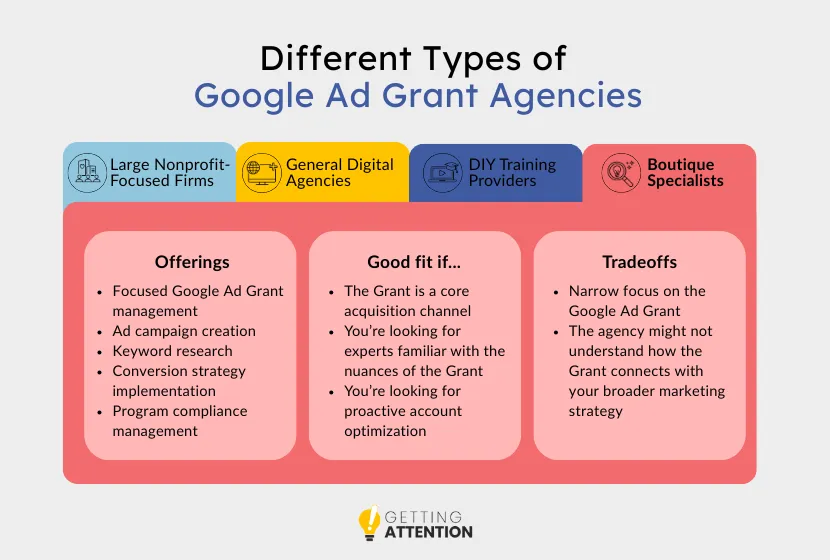
Boutique specialists focus almost exclusively on Google Ad Grant management. Unlike broader agencies, they’re not dividing attention across multiple services. Their work centers on building effective campaign structures, improving keyword targeting, increasing conversion rates, and maintaining compliance over time.
Since their focus is narrow, they’re able to spend more time on the details that drive results, which can make the Grant significantly more effective over time.
What do boutique specialists offer?
These agencies are deeply familiar with the nuances of the Ad Grant program, including compliance requirements, keyword strategy within restricted environments, and how to structure campaigns that actually drive meaningful conversions.
Since they spend the majority of their time working within Ad Grant accounts, they tend to be more proactive about optimization. That includes refining keyword lists, testing ad variations, improving quality scores, and identifying opportunities to better align ads with high-performing landing pages.
Agencies like Getting Attention may also extend their work beyond the ads themselves, offering recommendations on content and user experience, since those factors directly impact conversion rates.
Where do boutique specialists work best?
This model works well for nonprofits that treat the Google Ad Grant as a core acquisition channel rather than a side project. If you’re aiming to drive consistent conversions, like donations, program sign-ups, or applications, but don’t have the internal capacity to manage ongoing optimization, a specialist brings the skill needed to get there.
What are the tradeoffs of working with boutique specialists?
The main tradeoff is scope. Boutique specialists tend to stay focused on the Ad Grant, which means you might need other partners for things like content, paid social, or broader strategy. However, for some nonprofits, that’s actually a benefit. Each partner focuses on what they do best, and the Ad Grant gets the level of attention it usually doesn’t in a more general setup.
Getting Attention is an example of a specialist who leans into depth without losing sight of how everything connects. Yes, we focus heavily on Google Ad Grant management, but not in a vacuum. We look at how your ads interact with your content and landing pages, as well as your broader marketing – because performance rarely improves by tweaking one piece in isolation!
The usual tradeoff with boutique agencies is that things can feel siloed. In practice, that only happens when the agency stays in its lane too rigidly. Our approach is a bit more fluid. We stay focused on what we do best while still thinking about how it fits into the bigger marketing picture, so you get the benefit of specialization without feeling like you’re managing disconnected parts.
Why nonprofits switch Google Ad Grant agencies (based on what we’ve seen firsthand)
Great, you’ve got your agency options down! Next, we want to help you learn from the experiences of other nonprofits that have worked with frustrating types of Ad Grant managers.
After partnering with dozens of nonprofits that came to us while working with other Ad Grant vendors, we noticed a pattern. We had a chat with our current clients and put together the most common reasons nonprofits make a switch:
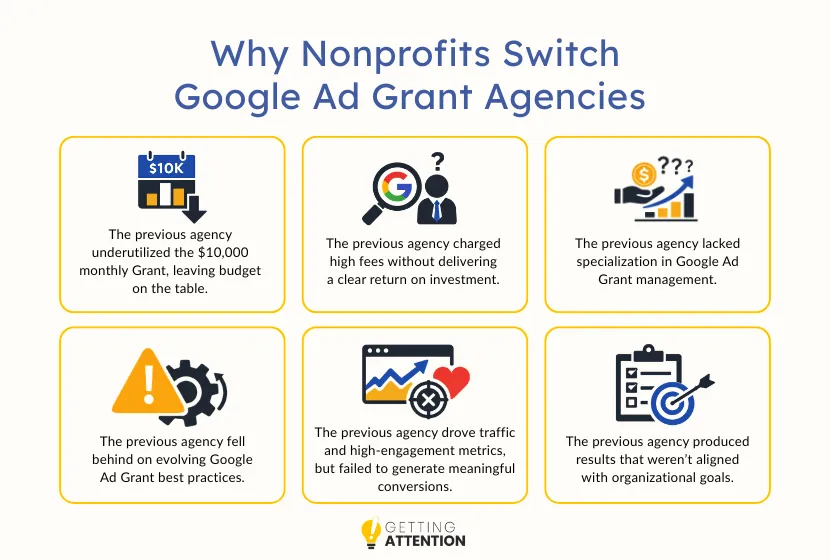
1. Underutilizing the $10,000 monthly grant and leaving budget on the table
One of the clearest signals that something isn’t working is underutilized spend. The Google Ad Grant gives you access to up to $10,000 per month, yet many nonprofits we work with were spending far less before switching providers.
At first glance, that might not raise alarms. If ads are running and traffic is coming in, partial spend can feel acceptable. But in practice, that can point to deeper strategic gaps, like limited keyword coverage, poor campaign structures, or a lack of expansion into new audience segments. These can all restrict how much of the Grant is actually used, and can hurt other, even more important performance outcomes.
Every dollar left on the table is visibility you’re not capturing, opportunities you’re not creating, and audiences you’re not reaching. Over time, that adds up to a significant loss in potential impact.
Stories from our clients
Before switching, the National Comedy Center (NCC) was only using about $3,000 of its $10,000 monthly Ad Grant. Climate Ride ran into a similar issue, working with an agency that struggled to use the budget effectively. Capital IDEA saw even less traction, with under $600 spent each month. In each case, most of the Grant was simply left on the table.
Once they partnered with Getting Attention, NCC increased its spend by $6,900 in 6 months, Climate Ride’s spend went up by $8,314, and Capital IDEA scaled spend by over $8,000 – all while simultaneously increasing click-through rates (CTR) and meaningful conversions.
2. Lacking expertise in Google Ad Grant management
Many nonprofits come to us after working with general marketing agencies that include Google Ad Grants as one of many services. While these agencies often have strong capabilities in paid advertising, the Ad Grant operates under a different set of rules that require a more specialized approach.
We’ve seen accounts where the fundamentals of paid search were present, but the nuances of the Grant were not fully accounted for. Campaigns were structured in ways that made sense for standard ad accounts, but did not translate effectively within the constraints of the Ad Grant program.
Expertise matters because the margin for error is smaller. Success depends on understanding not just how Google Ads works, but how the Ad Grant specifically operates, and how to build a strategy within those boundaries.
Stories from our clients
Before partnering with Getting Attention, Kids Saving the Rainforest (KSTR) worked with a general marketing firm. However, the firm didn’t have expertise in the Ad Grant, so despite running several campaigns, KSTR hardly saw any traction or conversions.
With Getting Attention, that changed quickly, bringing spend up to $9,918, increasing clicks by 161%, and driving a 13x jump in conversions.
3. Charging high fees without delivering a clear return on investment
Cost becomes a sticking point when results feel disconnected from what you’re paying for. Many nonprofits we’ve worked with were not necessarily looking for the cheapest option, but they were looking for a partner who could justify the investment through consistent, measurable performance.
If your Google Ad Grant agency is managing your account month after month, you should be able to see how that work is translating into stronger results, such as more conversions, better use of budget, and clearer alignment with your goals.
Stories from our clients
The National Comedy Center (NCC) started looking for a new Google Ad Grant agency when their previous agency, a well-known player in the Ad Grant space, raised their price by 50% without any new services or details about how this would improve results and increase ROI. Similarly, A Window Between Worlds (AWBW)’s previous agency increased costs without improved results to show for it, so they decided to look for another partner.
Both agencies eventually went with a more cost-effective option (that’s us!) that fit into their budget and also delivered better results. At $600 a month, NCC increased its conversions by 298%, while AWBW garnered an additional 14,600 clicks and more than 5,000 conversion actions.
4. Falling behind on evolving Google Ad Grant best practices
Google Ad Grant policies change, performance expectations shift, and new features are introduced over time. More recently, broader changes in how search operates, including the influence of AI, have also started to reshape how campaigns perform. We often see accounts that were set up correctly at one point but have not been meaningfully updated in years.
An effective Google Ad Grant agency treats the account as something that evolves over time. That means regularly reviewing performance data, testing new approaches, adjusting to policy updates, and rethinking strategy as the platform itself changes.
Without that ongoing refinement, even well-built accounts can lose effectiveness.
Stories from our clients
Goodwill of Central Iowa used to work with an agency that managed their Ad Grant for them, but they came to the decision that they would get better results and performance with an agency that was up to date with following best practices.
After switching to Getting Attention, their account was restructured and optimized, leading to a doubling of impressions and an increase in CTR from 21.76% to 30.32%. With improved tracking in place, their campaigns began supporting meaningful outcomes rather than surface-level metrics.
5. Driving traffic and high-engagement metrics, but failing to generate meaningful conversions
High traffic numbers can feel reassuring, especially when reports highlight steady growth in clicks and impressions. But traffic on its own does not move your mission forward – what counts is what happens after someone lands on your site.
What nonprofits are ultimately looking for, and what often leads them to switch agencies, is a clearer connection between effort and outcome. They want to understand how their Google Ad Grant is contributing to their mission in concrete terms.
The general pattern is that increased spend = increased conversions, but if there’s ever a time when those two goals are in conflict, Getting Attention will optimize for conversions every time. We build out a conversion strategy that’s designed first and foremost to support the client’s bottom line and then secondarily to achieve other outcomes like 100% Grant utilization. That’s part of why our return on investment (ROI) is usually favorable!
Stories from our clients
A Window Between Worlds (AWBW) specifically wanted to shift toward actions that impact the bottom line (calls and donations), but their previous vendor was only able to bring traffic and impressions. They wanted to use the Grant to attract more trainees, workshop attendees, and most importantly, donors.
Erika’s Lighthouse ran into a similar issue. While their previous agency generated impressions and clicks, those numbers didn’t lead to their priority actions, like recruiting classroom ambassadors or driving fundraising sign-ups. Additionally, much of the traffic came from people searching for counseling or medical services, which weren’t aligned with what they actually offer.
With Getting Attention, both organizations saw a positive shift in performance. After getting a clear sense of AWBW’s priorities, our Grant specialists refined the keyword strategy to intentionally target people who are likely to sign up for their programs and donate.
To support Erika’s Lighthouse’s primary goals, our team focused keyword research on social workers, teachers, and school administrators — those most likely to bring suicide prevention and depression awareness training into classrooms. We also added negative keywords to keep clicks aligned with their mission of awareness, not treatment.
6. Producing results that weren’t aligned with organizational goals
An account may show steady increases in traffic or engagement, but those gains do not translate into program participation, donor growth, or community impact. The campaigns are active, but they are not supporting the priorities that matter most to the organization. This usually happens when a strategy is built around generic performance metrics rather than mission-driven objectives.
A strong Google Ad Grant agency starts by defining success in concrete terms. They ask these questions:
- What actions are most valuable to the organization?
- Which audiences are most likely to take those actions?
- How does each campaign contribute to those goals?
Without that alignment, even well-managed campaigns can feel disconnected from the bigger picture.
Stories from our clients
City Leadership also wasn’t happy with the results they were getting from their previous Grant manager. Their campaigns weren’t fully spending, and more importantly, their ads weren’t reaching the right audience needed to meet their goals.
The Museum of Contemporary Art (MCA) Denver faced a different but related issue. They were using a free management service, which reduced costs, but performance was underwhelming. The limited results they did see didn’t align with their growth goals, making the effort difficult to justify.
Our specialists at Getting Attention helped increase City Leadership’s spend by $8,000 and reached a 10.8% CTR, with campaigns targeting the audiences most relevant to their programs. MCA Denver increased spend by $7,198, boosted clicks by 109%, and drove 2,933 conversions tied to their actual engagement goals.
Is Getting Attention the right Google Ad Grant partner for your nonprofit?
We work with a lot of nonprofits, and we always make sure we’re a good match in terms of goals and working style. Over the years, we’ve found that the right fit is usually an organization that values ongoing management and wants a partner who is consistently reviewing, adjusting, and improving performance on an ongoing basis.
We’re not the right partner if:
- You prefer to manage your Google Ad Grant internally and are mainly looking for occasional guidance rather than hands-on support. If this is you, we recommend checking out our resources and signing up for our free webinars and events!
- You are looking for a one-time setup, audit, or short-term coaching engagement and then plan to take things from there, since we focus on continuous optimization rather than set-it-and-step-away work.
- You’re looking for a team to manage other channels (like social media or email marketing) on top of the Grant. We focus fully on Ad Grant strategy and performance, along with the additional services for paid ads and website content, which help those campaigns succeed.
We’re the right partner if:
- You want your Google Ad Grant to actively support your broader marketing strategy. A core piece of our view of the world is that we’re Google specialists, but our work can help amplify other channels like email or social! We also play well with others, in case you have other existing vendors.
- You are looking for full-service Grant management that goes beyond initial setup and into ongoing optimization, testing, and refinement based on what the data is showing.
- You expect clear conversations about performance, with a focus on conversions and ROI instead of vanity metrics.
- You want consistent, monthly reporting and live check-ins with someone who understands your account deeply and can speak to both the details and the bigger picture.
You’ve read this far – surely you’re at least a little curious about what a partnership with us could look like. Set up a free consultation with our team – we’ll tell you more than this page can!
Why Getting Attention works for nonprofits that want better Ad Grant results
We’ve designed our service model to feel less like hiring a vendor and more like adding a highly specialized teammate who just happens to sit outside your organization. The way we structure our work is what allows us to stay both responsive and effective over time.
But if you’re a fan of lists, here are five specific things that make Getting Attention a top choice for nonprofits that want better Ad Grant results:
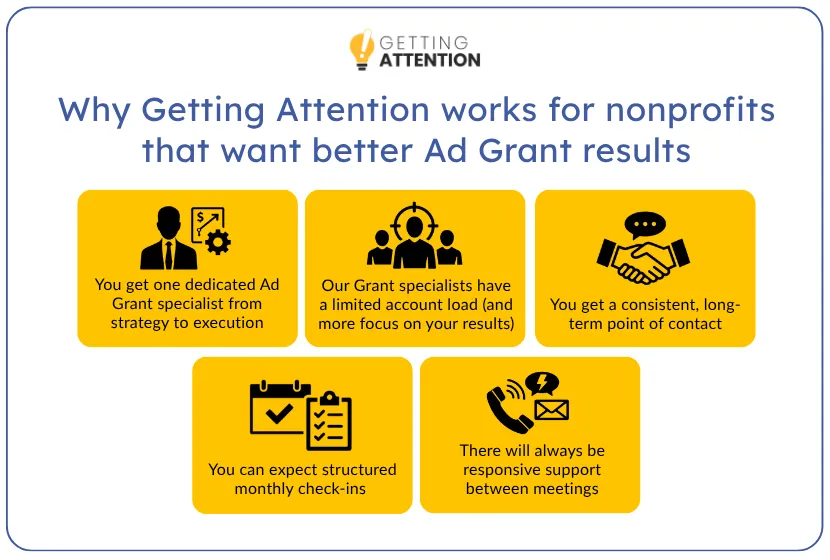
1. You get one dedicated Ad Grant specialist from strategy to execution
Your account manager is also your strategist and your implementer – the same person who is building campaigns, refining keywords, and analyzing results is the one sitting with you in monthly meetings, too. There is no internal handoff, no loss of context, and no disconnect between strategy and execution. We change account managers handling the account only in exceedingly rare circumstances!
2. Our Grant specialists have a limited account load (and more focus on your results)
Each account manager works with a limited number of nonprofits. It gives them the space to work on your account, review performance trends, test new ideas, and make thoughtful adjustments instead of rushing from one account to the next.
3. You get a consistent, long-term point of contact
Most of our clients work with one dedicated point of contact for the duration of their time with us. Over time, that relationship becomes more than just transactional. Your account manager learns the nuance of your programs, the language that resonates with your audience, and the outcomes that matter most to your team.
That familiarity shows up in the work. It allows us to make better, faster decisions without constantly starting from scratch or re-learning your organization.
4. You can expect structured monthly check-ins
We meet monthly to walk through performance, talk about what is changing, and outline what we’re testing next. These meetings are structured, but they are also practical. Aside from reporting numbers and metrics, your dedicated specialist translates that data into clear next steps and decisions. It’s a premium level of service!
5. There will always be responsive support between meetings
Outside of those check-ins, we stay accessible. If something comes up, like a question, a shift in priorities, or a new campaign idea, you won’t be waiting weeks for a response. Reach out to us, and we’ll respond ASAP. All questions are addressed same-day, and most campaign build requests can be handled within 2-3 business days.
Next Steps for Your Google Grant Strategy
Applying for and maintaining your Ad Grant account is no walk in the park. Turning to a professional Google Grant agency, like Getting Attention, is your best bet.
Getting Attention is a Google-certified full-service agency that focuses on the Google Ad Grant as its main service. We’ll handle every aspect of your account, starting with eligibility confirmation through ongoing maintenance, and can create optimized on-site content. In no time, you’ll start driving more conversions, connecting with more prospects, and generating great results for your cause!
Are you interested in learning more about Google Ad Grants or marketing your mission effectively? Check out these great additional resources:
- Google Ad Grants: The Complete Guide + How to Get Started. Curious about all the good that Google Ad Grants can do for your organization? Check out our complete guide where we cover everything from eligibility requirements to insider tips.
- Nonprofit Marketing: Proven Tips to Reach Your Supporters. Google Grants are just one part of a holistic marketing strategy. Learn more about the different components in this complete guide.
- How to Hire A Google Grants Agency + Best Firms. Want to learn more about outsourcing grant management to an expert? Take a look at Double the Donation’s complete guide and recommendations!