How to Apply for Google Grants: 4 Easy Steps for Approval
Last Updated on June 24, 2026
- Eligible 501(c)(3) nonprofits receive $10,000 in monthly search ad credits to boost visibility and donor reach.
Read full summary ▾
- The approval window typically lasts two to 14 days, but you should plan for a three-week buffer to handle potential paperwork delays or verification hurdles.
- Technical “must-haves” include a secure HTTPS website, a clear mission statement displayed in your footer, and at least 300 words of original content on core pages.
- Maintaining the grant requires a 5% minimum click-through rate and account updates at least every 90 days.
We talk about the specific four-step application framework and the technical website standards required to satisfy Google’s modern AI review systems. Additionally, this guide covers how to align your digital presence with E-E-A-T signals to move from a pending status to a fully approved, high-performing ad account.
Are you looking to drive more traffic to your website without tapping into your limited marketing budget? The Google Ad Grant program will help you do exactly that! After completing the Google Grant application process, you’ll receive $10,000 every month to spend on Google Ads.
With these ad credits, nonprofit organizations can find supporters, spread awareness about their causes, increase volunteer signups and donations, and support other initiatives by having their mission appear at the top of the search results.
This funding is a major boost for any nonprofit, but it all starts with getting that application approved. To help you get there, we’ve put together this guide to walk you through the process.
We’ll cover these topics:
- What is the Google Ad Grant?
- The Google Ad Grant application process: 4 steps for easy approval
- How to apply for the Google Ad Grant in an AI-moderated review environment
- Common Google Ad Grant application mistakes nonprofits make
- Real case studies of nonprofits whose Google Ad Grant we helped get approved
- What should you do after your Google Ad Grant application gets approved?
- What should you do if your Google Ad Grant application gets rejected?
- How experts like Getting Attention can help you apply for the Google Ad Grant
- Final thoughts on applying for the Google Ad Grant
- Frequently asked questions (FAQs) about the Google Ad Grant application process
As a Google-certified Ad Grant management agency, Getting Attention helps nonprofits get the most out of the Google Ad Grant program. We’ve helped over 100 nonprofits get approved with a 100% success rate, and we’d love to help you, too!

What is the Google Ad Grant?
The Google Ad Grant provides eligible 501(c)(3) organizations with $10,000 every single month to spend on Google Search ads. When someone types “how to help foster kids” or “animal shelters near me” into Google, for example, your nonprofit can appear at the very top of the results. As long as you stay compliant, that $10,000 refreshes every month, giving you massive reach.
Since Google generates more than 80% of desktop search traffic in the United States alone, this program can help boost your nonprofit’s visibility and garner more support for your cause. All you have to do is follow the required Google Ad Grant application process and get approved.
Take Action Against Hunger, for example. They used the Grant to bring in 158,000 new visitors to their website and raise over $66,000 in just 12 months. It’s a clear example of what the program can do — but getting there starts with being familiar with Google’s eligibility and application requirements.
How do I get a Google Ad Grant?
To apply for the Ad Grant, you’ll need to go through an application process with several steps, including proving your eligibility, setting up the right accounts, and building your first ad campaign.
Google wants to see that you’re a legitimate nonprofit with a clear mission. They also want to make sure your website provides helpful and substantial information that people can get value from.
To move through the process faster and avoid getting rejected, we recommend working with Google Ad Grant experts like our team here at Getting Attention.
How long will it take to apply for the Google Ad Grant?
The Google Ad Grant application process itself doesn’t take long to complete. Typically, if you have your tax documents handy and your website is in good shape, the active work takes just a few days. The biggest time sinks usually have to do with some pre-qualifying steps that may take some time.
For example, if you’re already signed up for Google for Nonprofits (G4N), applying for the Google Ad Grant will likely take about 2 to 14 days. If you’re not yet registered, though, you’ll need to apply for and get approved for a G4N account first before you can move forward.
How long does it take to get approved for the Ad Grant?
Google usually takes two to fourteen days to review Google Ad Grant applications. We’ve seen these timelines shift depending on the time of year and the volume of requests, so we typically recommend planning for a three-week window to give yourself plenty of cushion.
The Google Ad Grant application process: 4 steps for easy approval
You’ve probably heard of nonprofits running into delays during the application process. We see it happen often, and based on our experience, the best way to keep things moving is to get every detail right from the very beginning.
We’ve broken down the process into four clear steps, including some insights and tips from our Ad Grant specialists!
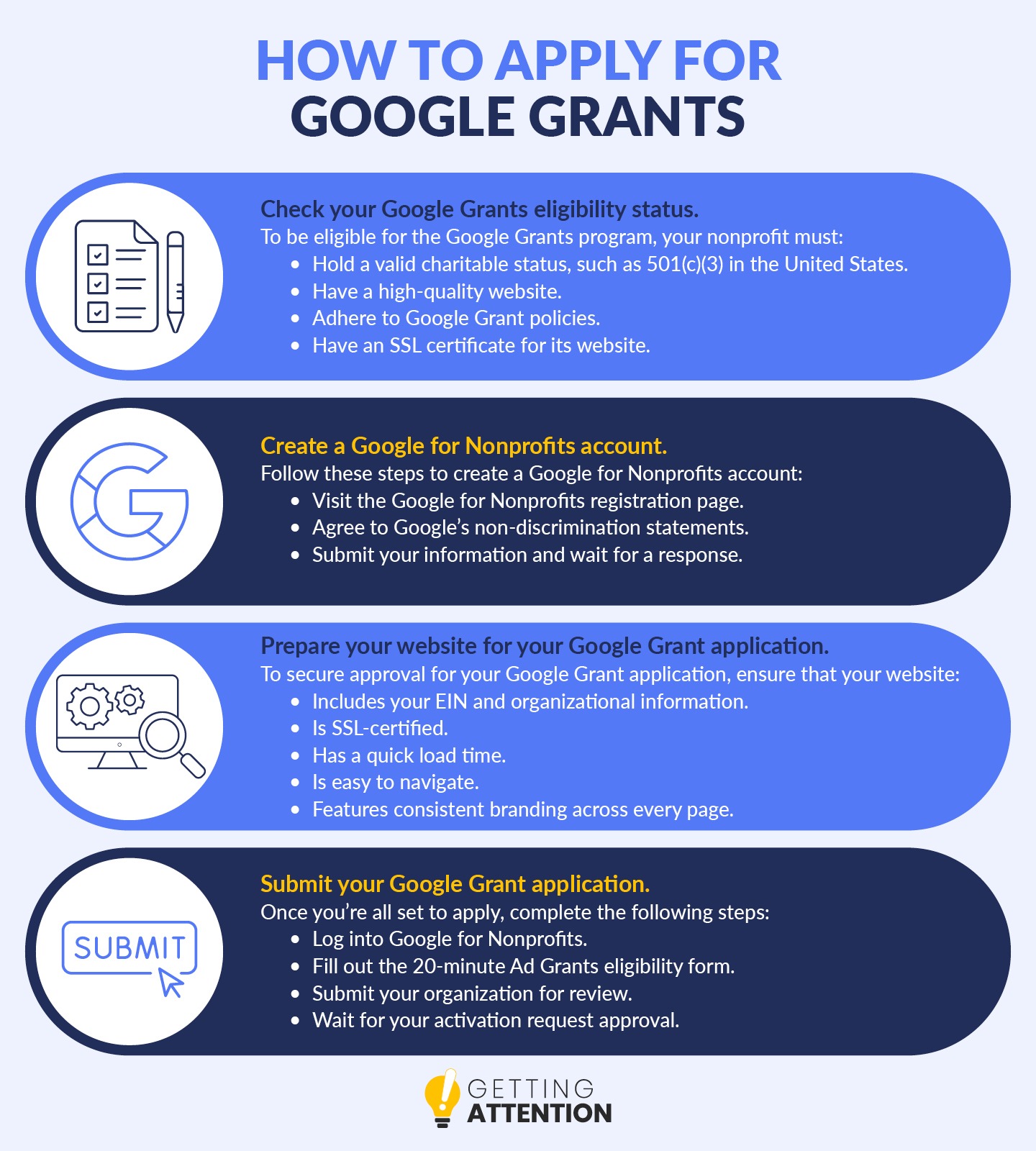
Step 1: Check your Google Ad Grants eligibility status
To qualify for the Google Ad Grant, your nonprofit must meet specific criteria regarding charitable status, website quality, and policy compliance.
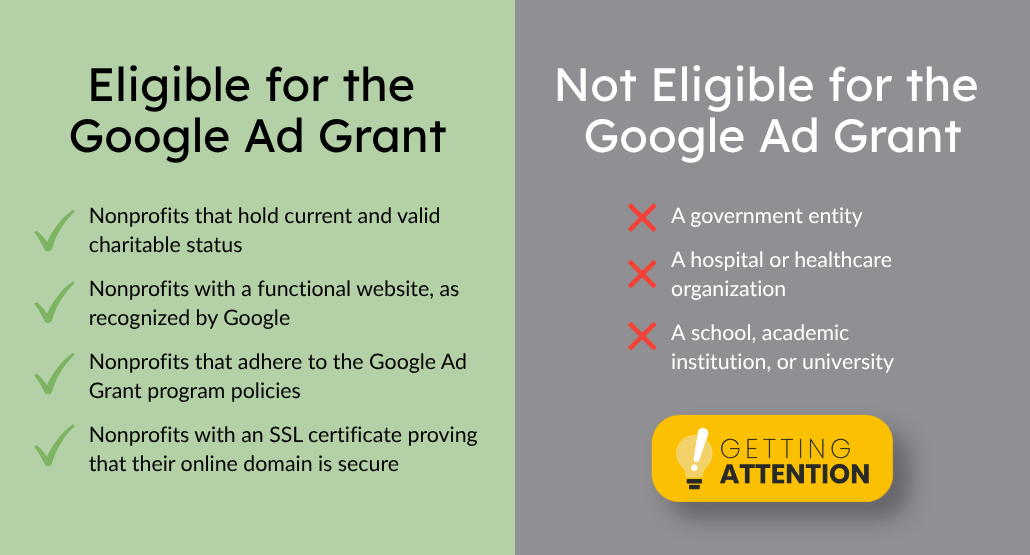
Since the program is available in over 50 countries, make sure you check the specific guidelines for your location on the official Google for Nonprofits eligibility guideline page.
If you’re in the United States, you’ll need to meet the following requirements to be eligible:
- A current and valid charitable status, which in the United States means registering as a 501(c)(3) organization with the IRS.
- A functional website with original, mission-relevant content that provides value to visitors (as opposed to generic or low-quality AI-generated content).
- Adherence to Google Grant program policies, including registration with Google for Nonprofits.
- An SSL (Secure Sockets Layer) certificate indicating that your online domain is secure.
However, even if you check all the requirements above, there are still types of nonprofits that are automatically ineligible for the Grant. Google doesn’t offer the program to these types of nonprofits:
- Government entities and organizations
- Hospital and healthcare organizations, though nonprofits working in the healthcare space (such as breast cancer research or Alzheimer’s awareness organizations) are still eligible
- Schools, academic institutions, and universities, though philanthropic arms of educational institutions still qualify
If your organization falls into one of the ineligible categories, consider looking into other Google programs that might fit your mission better. For example, Google for Education offers plenty of tools and specialized benefits specifically for schools and academic institutions.
Additional Google Grant application requirements
Once you know you qualify, you’re just about ready to jump into the application process. There are just a few more boxes you need to check before you officially start.
You need to make sure:
- You have a live, fully-functional website for your ads to point to.
- Your site doesn’t already run any revenue-generating ads, like Google AdSense.
- You (or your team) are ready to handle the ongoing work of picking keywords and keeping your campaigns updated.
Doing this prep work now will help you breeze through the actual application much faster!
Google Ad Grant Specialist Insights
- Make sure your 501(c)(3) status is currently active with the IRS through the Tax Exempt Organization Search.
- Check that your website clearly displays your mission and your EIN (tax ID).
- Make sure you aren’t using a “free” domain like yourname.wixsite.com. You need a dedicated domain like yourname.org to show Google you’re a professional, established entity.
- If you need help checking your eligibility or need specialists to help with the application process as a whole, set up a free consultation with Getting Attention!
| Arielle Sollo Google Ads Account Specialist at Getting Attention |
 |
Step 2: Create a Google for Nonprofits account
Once you know you qualify, your first official task is joining the Google for Nonprofits “club.” It’s an umbrella account that unlocks the Ad Grant, plus a few other great perks of signing up for a G4N account that you can start using right away:
- The YouTube Nonprofit Program: It’s a great way to tell your nonprofit’s story and share your mission through video, which usually does a much better job of building empathy and connecting with people than text alone.
- Google Earth and Maps: If you want to show exactly where your work is happening, this helps you create data visualizations and literally put your organization’s impact on the map.
- Google Workspace: You’ll get access to the tools most of us already use every day, like professional Gmail, Docs, Drive for storage, and Meet for your team calls.
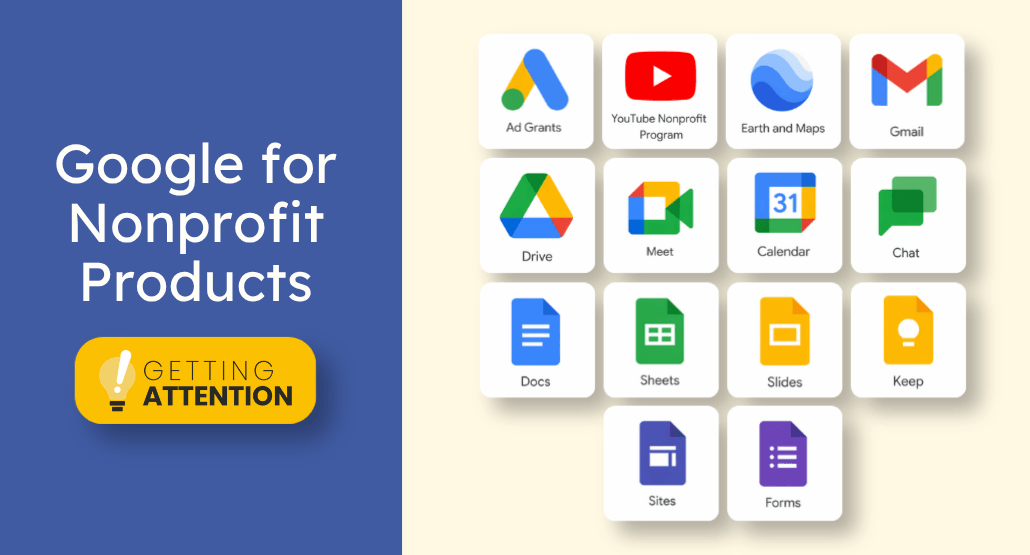
If this sounds like a win for your team, follow these steps to get your Google for Nonprofits account set up:
- Visit the Google for Nonprofits registration page.
- Agree to Google’s non-discrimination statements.
- Fill out the subsequent forms, including contact and organization information.
- Submit your request and wait for a response!
When you request a Google for Nonprofits account, Google’s verification partner, Goodstack, will verify your organization’s eligibility.
Google Ad Grant Specialist Insights
- Make sure you sign up with an email address you check often because Google will send all your account updates and important info about your Ad Grant there.
- Always use an email address ending in your nonprofit’s domain (like director@yournonprofit.org) rather than a personal Gmail account.
- Have your official legal address and tax ID ready so everything matches your IRS records.
| Jenelle Condado Google Ads Account Specialist at Getting Attention |
 |
Step 3: Prepare your website for your Google Ad Grant application
When you apply for the Grant, Google is going to take a good, hard look at your website. They want to make sure it’s high-quality, trustworthy, and actually helpful for anyone who lands on it.
Google will run through a checklist of conditions regarding the quality of your website before approving your application. While getting approved might be your main goal at the moment, a better website means that when people finally click on your ads, they stay on the page and support you.
Let’s walk through a few simple ways to polish your site and get it application-ready!
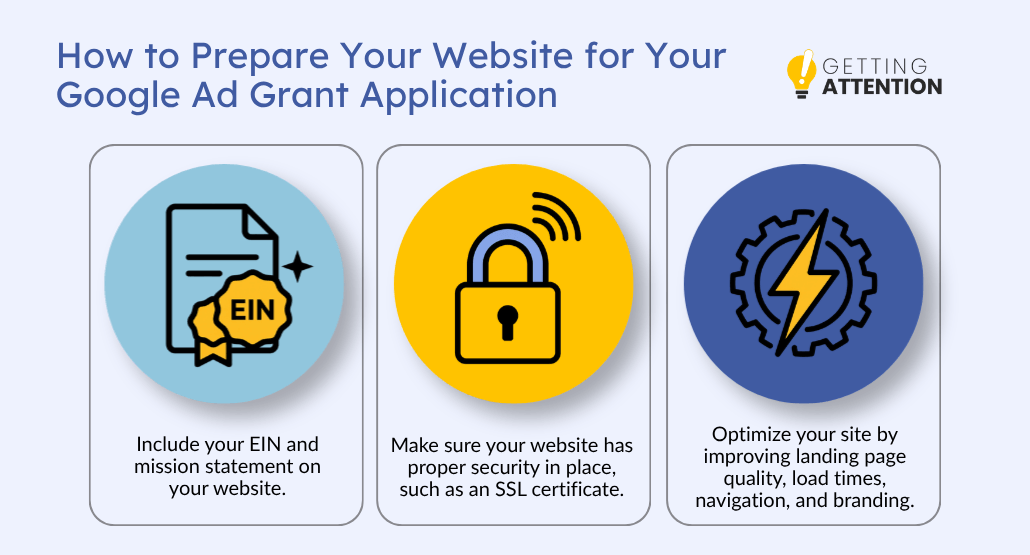
Include your EIN and mission statement on your website
Google needs to see a clear explanation of who you are and what your organization does. It’s a requirement for the Grant, but it’s also just good practice. When someone lands on your site, they want to know right away if your values match theirs before they decide to support you.
While displaying your EIN (your tax ID) isn’t technically a must for U.S. nonprofits in Google’s eyes, we always recommend it. There’s no security risk in sharing it (it’s already publicly available for anyone willing to peruse government databases), and it acts like a badge of trust. It proves you’re a real, registered 501(c)(3) to anyone thinking about donating or volunteering.
The easiest way to do it? Just drop your mission statement and EIN into your website’s footer. It’ll show up on every single page automatically, staying out of the way of your main design while still being there for anyone (or any Google bot) looking for it. Elegant!
Implement the proper security measures for your website (SSL Certificate)
To comply with Google’s website policy and keep your visitors safe, your website needs to be secure. The standard way to do this is with an SSL certificate. It might sound a bit technical, but it’s basically just a layer of protection that encrypts or scrambles sensitive info (e.g., credit card numbers or addresses) so hackers can’t get to it.
You can tell if a site is protected just by looking at the URL. If it starts with https (the “s” stands for secure), you’re good to go. If it’s just http, Google Chrome will actually slap a “Not Secure” warning in the address bar for everyone to see.
Nothing scares off a potential donor faster than a big red warning saying your site isn’t safe. Getting that certificate is a quick way to show people they can trust you with their information.
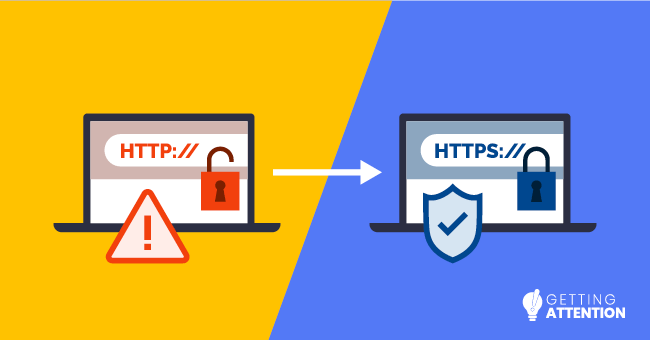
Having an SSL certificate is also a huge boost for your organic traffic. According to Google’s Transparency Report, Google Chrome users on Windows, Android, and Mac all spend over 90% of their browsing time on HTTPS sites. Google, among other search engines, uses SSL certification as a ranking factor. Not having an SSL certificate can actually hurt your rankings!
To get an SSL certificate, Hubspot recommends that you verify your website’s information through ICANN Lookup, generate the Certificate Signing Request (CSR), validate your domain by submitting your CSR to the Certificate Authority, and install the certificate on your website.
Quick Tip: Most modern website hosts (like Squarespace, Wix, or even some WordPress hosts) actually offer these for free and can turn them on with one click. Check your hosting settings first before you go through the manual process — it might save you a ton of time!
Optimize your site
Your website needs to look good, work well, and actually give people what they’re looking for. If you want to make the most of those Google Ad clicks, the main things to focus on are:
- Landing pages: These are the specific pages people land on after clicking your ad, like your donation form or volunteer sign-up. Since you’re paying (with Grant money) to get people here, you want these pages to be clear and convincing so visitors take action.
- Load times. Research says we’re all a little impatient online. If your site takes longer than three seconds to load, about 40% of people will just give up and leave your site. To speed things up, try shrinking your image file sizes and clearing out any old plugins or unnecessary code you don’t really need. You can also analyze your site’s load times for free with PageSpeed Insights.
- Navigation. If you’ve ever struggled with the menu at the Cheesecake Factory, you know it’s best not to overwhelm people with too many choices. Stick to your most important pages in the main menu so visitors don’t get lost. If you have a ton of content, adding a search bar is a smart move.
- Branding. If a user clicks a link and thinks they’ve somehow ended up on another site, that can come across as untrustworthy. Make sure every page on your site reflects your nonprofit’s brand by including your official colors, logo, and voice, so visitors know they’re in the right place.
Google Ad Grant Specialist Insights
- Aim for at least 300 words on your core pages to prove you’re an authoritative resource and keep your Quality Score high.
- Your landing pages must directly match the keywords you’re bidding on so Google considers your ads relevant and helpful.
- Flesh out your “About Us” and “Programs” pages with specific details. For example, you can replace generic mission statements with clear descriptions of your current projects, who you’re helping, and the tangible impact you’re making.
- Clean up any broken links or 404 errors on your site.
- Don’t have the time to write hundreds of words for every program? Let Getting Attention handle the heavy lifting with our specialized content creation service, designed specifically to meet Google’s web content standards!
| Ysa Dionisio Google Ads Account Specialist at Getting Attention |
 |
There’s a big difference between having a website and having a website that converts. To help you bridge that gap, we put together a guide on how to create landing pages that turn visitors into supporters. Check out the guide and start DIY-ing your way to better results!

4. Submit your Google Ad Grant application
Once your Google for Nonprofits account is approved, you’ll receive an email from Google, and you can finally apply for the Google Ad Grant! Though we update this page regularly, Google is wily and makes changes on a dime. You can always find the most up-to-date activation steps in your Google for Nonprofits account.
The process currently looks like this: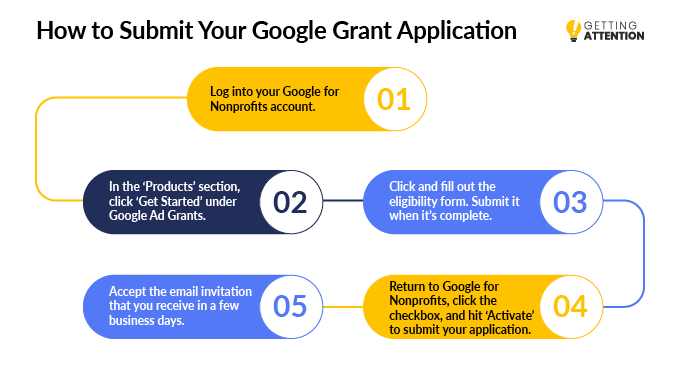
- Log into your Google for Nonprofits account.
- Click ‘Activate Products’ and then ‘Get Started’ under Google Ad Grants.
- Click the eligibility form link. This will prompt you to fill out an assessment with basic information such as your nonprofit’s registration number (EIN in the US), your organization’s physical address, and contact information. This should only take around 20 minutes.
- Return to the Google for Nonprofits homepage. Click the checkbox to verify you’ve completed the form. Then, hit ‘Activate’ to submit your organization for review by the Google Ad Grants team. This takes about 2-14 business days. You can go to your account page anytime to check the status.
- Accept the invitation. Once you’ve been approved, accept the email invitation from the Google Ad Grants team (make sure to accept both the Ads account setup and click through the billing profile as a formality). From here, start running your Google Ad campaigns! You’ll automatically receive $10,000 in ad credits per month so long as you maintain compliance with the program’s rules.
At this point, you’re all set to start creating your campaigns, spreading your message, and connecting with new prospects online.
Google Ad Grant Specialist Insights
- Do not create a “standard” Google Ads account on your own. Wait for Google to give you the specific Grant account.
- Check your spam folder for the approval email, as it sometimes gets lost there.
- Do not enter any credit card information, even if prompted to do so. Sharing billing information means you’ll be setting up a paid standard account, not a Google Ad Grant account!
- Note your customer ID number within your Google Ad Grant account. You can find this in the top right corner of the page, written in this format: XXX-XXX-XXXX.
| Arielle Sollo Google Ads Account Specialist at Getting Attention |
|
If you’re still confused about the process or you simply don’t have enough time in your day to apply, we fully recommend reaching out to a professional Google Grants agency. Our team is happy to chat about your needs and handle the entire Google Grant application process for you!
How to apply for the Google Ad Grant in an AI-moderated review environment
Google now utilizes sophisticated AI-moderated systems to screen websites and account structures for quality, security, and intent. If your site doesn’t send the right signals to these algorithms, you might find yourself at a disadvantage during the application process.
To get approved, your website needs to be technically sound and easy for these systems to understand. Google is looking for clear quality signals that show your nonprofit is credible and trustworthy, so it’s important to make your site as AI-friendly as possible.
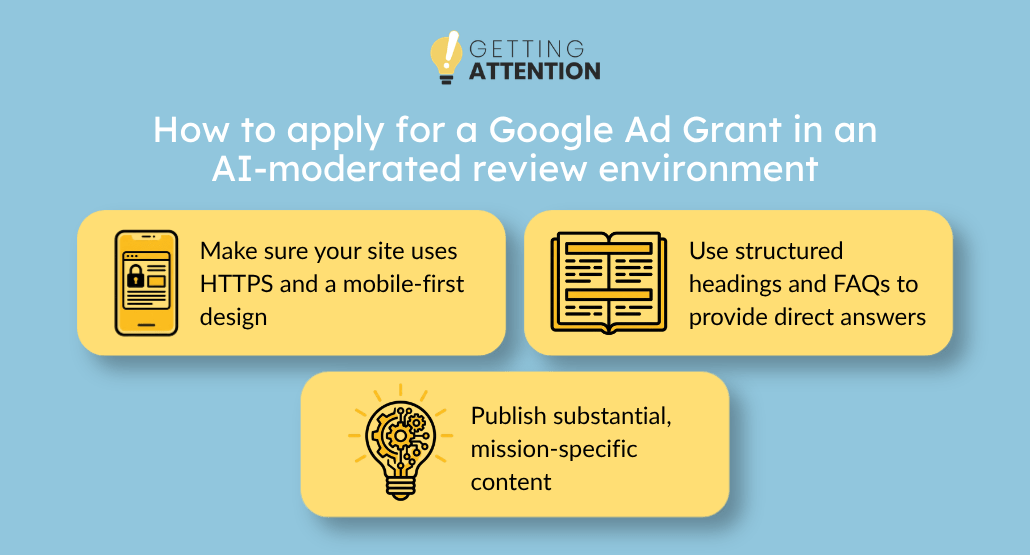
Follow these tips to stay aligned with Google’s expectations and improve your chances of approval:
Make sure your site uses HTTPS and a mobile-first design
Google uses automated crawlers (the same ones used for Search indexing) to verify security protocols. In 2026, failing an HTTPS or Core Web Vitals check can hurt your chances of getting approved.
Additionally, since most search traffic is now mobile, your site must be fully responsive (meaning it resizes content seamlessly between devices). Automated reviewers will evaluate your site’s landing page experience, and if the site is unencrypted or won’t work properly on mobile devices, it might be disqualified for failing basic quality standards.
Use structured headings and FAQs to provide direct answers
Modern review algorithms use Natural Language Processing (NLP) to categorize your organization’s intent. When you use a clear heading hierarchy (H1s and H2s) and scannable FAQ sections, you provide clear semantic signals.
This is a fancy way of saying that website crawlers don’t have all day to think about your content. By ensuring it’s well-structured and “skimmable” for the various robots to get the meaning quickly, you improve your chances of your content getting shown.
This lets the review system quickly map your website’s content to Google’s eligibility requirements, confirming that your services align with their mission-based policies.
Publish substantial, mission-specific content
Google’s helpful content system is now integrated into its vetting process. They look for E-E-A-T (Experience, Expertise, Authoritativeness, and Trustworthiness) in nonprofit websites, so generic, AI-generated, or “thin” content will likely compromise your application.
To pass the quality check, aim for original, organization-specific content on every page (ideally 300+ words). Your copy should clearly explain your specific programs, local impact, and unique EIN-verified details to prove to the algorithm that your site provides actual value to users.
Not sure if your website is ready for the Ad Grant just yet? We’ve put together a specialized checklist to help you audit your own site before you apply. Grab the checklist today!
Common Google Ad Grant application mistakes nonprofits make
At Getting Attention, we’re proud of our 100% application approval success rate. But we’ve also seen the challenges that often delay applications or straight up lead to rejections. That said, we also have some tips and insights on how to make sure it doesn’t happen to you.
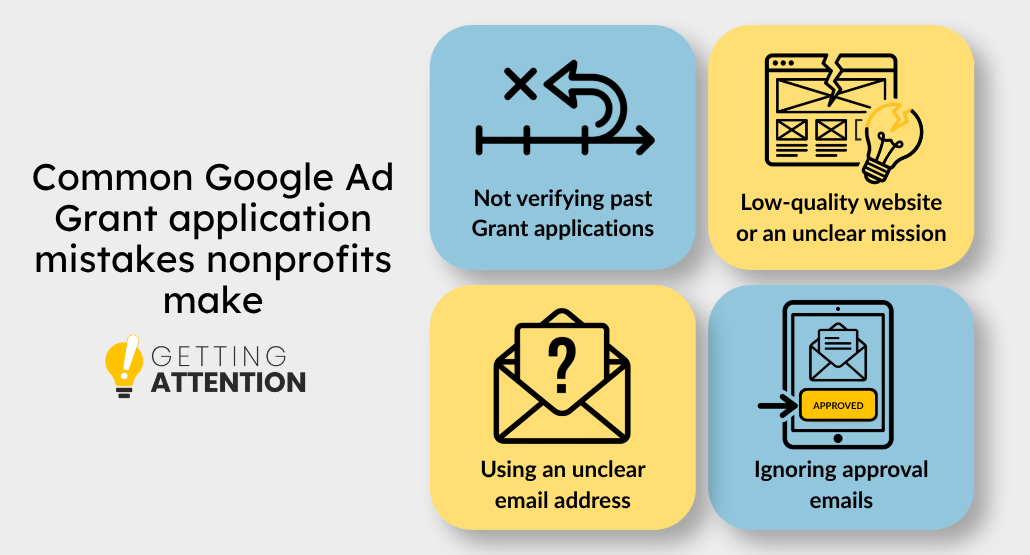
Some of the most common mistakes we’ve seen our nonprofit clients make during the application process include:
Not verifying if someone in the organization may have already applied for the Grant in the past
Before you start a fresh application, check if someone at your organization (perhaps a predecessor or a long-gone intern) already applied years ago. Google isn’t a fan of duplicate accounts. Plus, it’s much easier to get a pre-existing Grant reinstated.
Low-quality website and/or an unclear mission
If your website is messy or your mission is buried under three layers of jargon, Google’s reviewers will notice. They want to see a clear, functional site that immediately communicates what you do. If they can’t tell how you’re changing the world within ten seconds of landing on your homepage, they might just hit the “decline” button.
Using an unclear email address
Using a generic or personal email address that isn’t clearly linked to your nonprofit can raise red flags. A corollary to this: make sure the person applying is actually listed somewhere on the website (like a staff page). If Google can’t verify who you are within the organization, be prepared for a mountain of extra verification steps.
Not clicking the approval emails and setting up the accounts once you get confirmation
This one is a heartbreak: you get the approval, you celebrate, and then… you forget to actually set it up. Those confirmation and approval emails aren’t just for show—the links expire in just a few weeks. If you don’t click through and finalize the account setup immediately, you’ll have to start the dance all over again.
Google Ad Grant Specialist Insights
If you’re really struggling to get through the gates, try getting your account sorted with Goodstack first. They’re Google’s official validation partner, so getting things squared away with them is basically a fast pass for your application!
| Jenelle Condado Google Ads Account Specialist at Getting Attention |
|
Real case studies of nonprofits whose Google Ad Grant we helped get approved
Many nonprofits come to us after facing confusion, delays, or even rejection, unsure of what went wrong or how to fix it. Below are two examples of nonprofits we supported through that exact transition: from stalled or rejected applications to fully approved accounts ready to start using the Grant right away.
University Studies Abroad Consortium (USAC)

The University Studies Abroad Consortium (USAC) does incredible work helping students study abroad, but their Ad Grant application kept getting rejected. They were trying to rebuild their presence after the pandemic and couldn’t get Google to approve their Ad Grant application.
Getting Attention stepped in to audit their site and handle the application process. Once approved, our specialist built targeted ads for specific host countries and partner universities.
The Results
|
1.79K
Unique clicks
|
291
Conversions
|
6 mo
Time to results
|
Keeping Kids in School (KKIS)

Keeping Kids in School (KKIS) was doing important work in Mexico by providing scholarships and other forms of educational support. They wanted to use the Ad Grant to increase visibility and increase donations, but they were denied the Grant twice, making them doubt their eligibility.
Since KKIS already had a Google for Nonprofits account, our team at Getting Attention simply asked for admin access and got them approved immediately. We then built out ads that focused on their specific fundraising needs and awareness goals.
The Results
|
513
First-month clicks
|
29
First-month conversions
|
~3×
Growth by month 6
|

What should you do after your Google Ad Grant application gets approved?
Congrats! You’ve cleared the biggest hurdle: getting approved for the Google Ad Grant. Now that that’s over, it’s time to actually spend that $10,000 monthly budget effectively while keeping Google happy by complying with their rules and policies.
While many nonprofits find it easier to let a certified agency handle the Ad Grant management, here are the immediate next steps your team should take after getting approved:
Configure your Google Ads account
To get started, set up your first few campaigns. Within Google Ads, you’ll find the Campaigns tab on the navigation bar to the left.
Keep these tips in mind for a well-organized account:
- Follow the required account structure. Within each of your campaigns, you should have at least two ad groups. Within each ad group, you should have at least two active ads.
- Do plenty of keyword research. To choose ideal keywords for your campaigns, pinpoint search queries that receive a decent bit of monthly traffic and relate to your mission. Google even has a keyword quality score tool that will check the expected CTR, ad relevance, and landing page experience for your different campaigns.
- Use sitelink assets. These will allow you to link to specific parts of your website below your ads. This gives users additional options to click and interact with your cause. Typically, these include other pages relevant to the ad, like donation or volunteer signup pages.
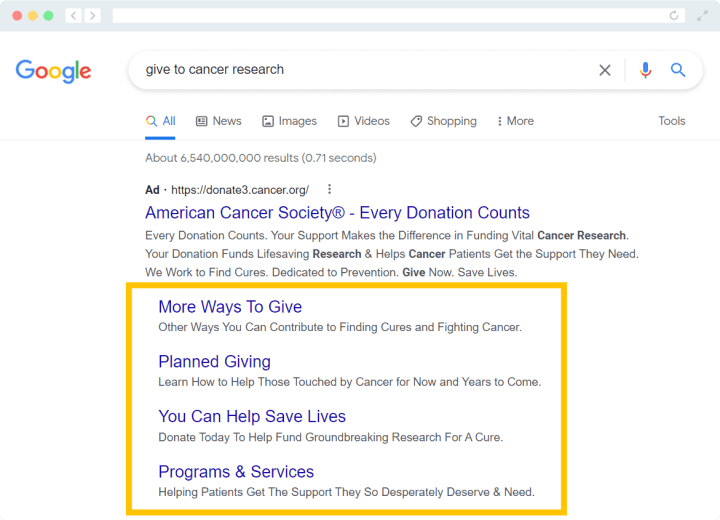
If you’re interested in learning more about setting up high-performing campaigns, check out our ultimate guide to optimizing your Google Grant account. In it, we dive into account management tips and requirements that will help you connect with your audience.
Meet Google Ad Grants compliance requirements
To retain your $10,000 monthly ad credits, your organization has to consistently meet Google’s program policies. Keep your account in good standing by keeping an eye on these:
- Account activity. Log in to your account at least once a month and update it every 90 days to prove to Google that you’re still using the Grant funding.
- Ad relevance and geotargeting. Double-check that your ads have specific relevance to their audience. You can do this by including geotargeting, so Google knows its users are receiving ads relevant to them.
- Monthly keyword evaluation. Google requires a Keyword Performance Report once a month to confirm that you’re optimizing your keywords for the best results.
- A minimum of 5% click-through rate (CTR). You must have at least a 5% CTR, starting at 90 days post-approval. This is proof that your ads are actually useful to users and relevant to their search intent. Accounts that fail to meet this requirement will be notified, and if they fail to meet a 5% CTR for two consecutive months, those accounts will be suspended.
Google implements these requirements to make sure you’re actually benefiting from the program. If you let compliance slide, you risk losing your funding and having the account deactivated. But as long as you’re checking in and making small tweaks over time, you’ll be in great shape to keep that impact growing!
What should you do if your Google Ad Grant application gets rejected?
Getting a rejection notice can feel like a major setback, especially when you are counting on those ad credits to grow your mission. However, a rejection is rarely the final verdict based on our experience.
If your application didn’t go through, here is how you can get things back on track:
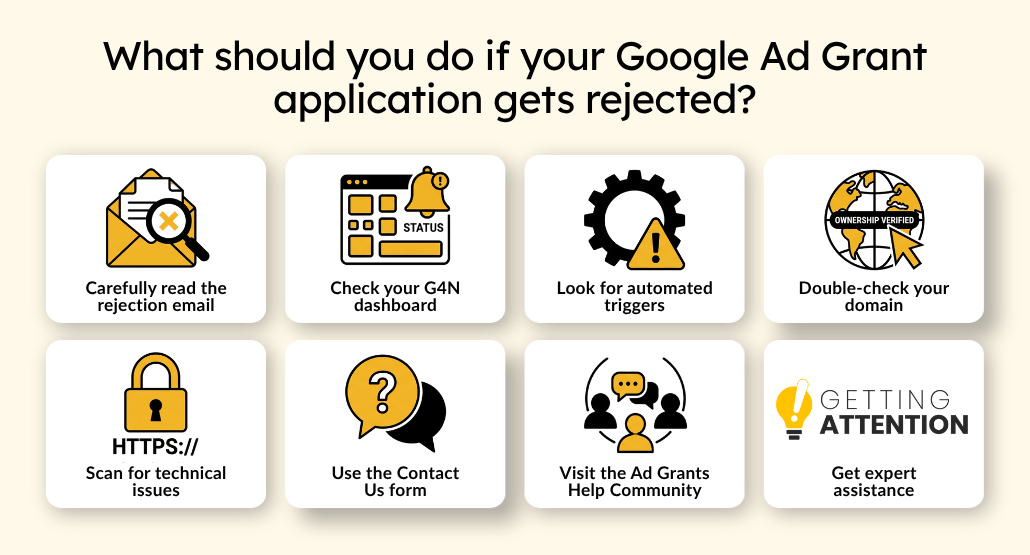
Read that rejection email carefully
Google usually sends an automated message. While it can be a bit generic, it will usually point you toward a general category like “website policy” or “account structure.”
Check your G4N dashboard
The dashboard can give you a little more information than the email does. Log in to your Google for Nonprofits portal and look for the status of your activation request – it often lists specific feedback there.
Look for automated triggers
Sometimes, the system flags your site for “Destination Requirements.” This is just another way of saying Google thinks your website is missing clear, original info, or that your site isn’t fully set up yet. Make sure your site feels like a complete, helpful resource.
Double-check your domain
Make sure that the website you put in the application is the exact one you own and have verified in your account.
Scan for technical issues
Is your site secure? Every single page needs a valid SSL certificate. If your URL starts with http instead of https, Google will likely reject the application.
Use the Contact Us form
Within your Google for Nonprofits dashboard or the Ad Grants Help Center, look for the “Contact Us” link. It usually takes you through a few troubleshooting questions first, but eventually, it will give you the option to submit a support ticket via email or chat.
Start a conversation in the Ad Grants Help Community
The Ad Grants Help Community is a forum where experienced Ad Grant experts (including us!) answer specific questions. If you post your rejection reason there, someone who has seen that exact error might chime in with the fix.
Get expert assistance
If you’re staring at Google’s feedback and can’t make sense of it, consider reaching out to a specialist or an agency like Getting Attention. We can audit your setup and tell you exactly what needs to change to get that “Approved” status!
How experts like Getting Attention can help you apply for the Google Ad Grant
For many nonprofits, $10,000 a month in free advertising is a marketing grant they can’t refuse. However, managing it can feel like a second full-time job. To actually see results, including more donations, more volunteers, and more eyes on your mission, you have to stay on top of constant updates, track every click, and comply with all of Google’s rules to avoid getting suspended.
With the weight of running a nonprofit already on your shoulders, many organizations turn to Ad Grant agencies like Getting Attention to handle the setup, management, and compliance for them!
Some valuable areas of assistance Getting Attention offers include:
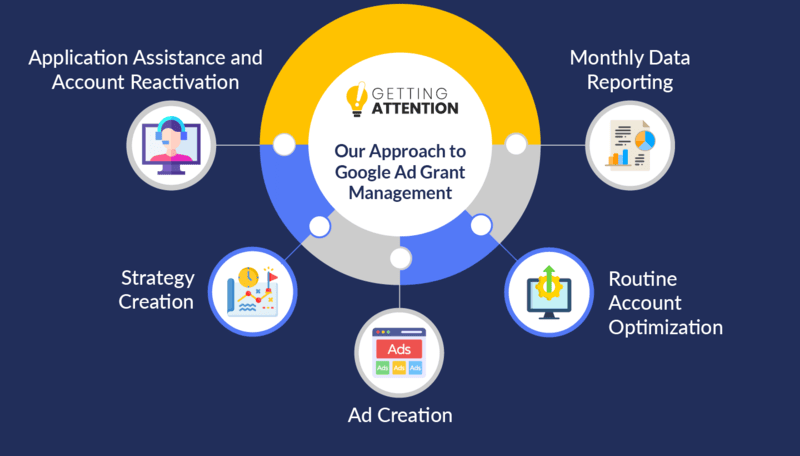
Assistance with applying for Google Ad Grants
Not sure if you qualify? Don’t sweat it. We’ll check your eligibility and guide you to complete your Ad Grant application. There’s no need for you to even understand how to apply for Google Grants beforehand since we’ll walk you through the entire process!
Strategy creation
We’ll help you pick goal-oriented conversion actions, such as donations, volunteer sign-ups, and event registrations. That way, your ads will be focused on advancing your mission.
Ad creation
Our Google Ad pros will create ads that promote your mission to likely supporters. Each ad will be backed by effective keyword research, so you can reach your target audience.
Routine account optimization
We’ll keep an eye on your ad performance to adjust bid strategies, tweak ad copy, and ensure compliance with Google’s rules.
Monthly data reporting
Every month, you’ll get a clear, transparent report that shows you exactly what’s happening: how many people clicked on your ads, how much of the ad credits you spent, and most importantly, how many of those people took action.
If you’re curious about how an agency can help you make the most of that $10k-a-month gift, we’d love to chat! Reach out to our team to discuss how we can support all your Google Ad Grant needs, from applying to the program to researching the best keywords for your cause.
Final thoughts on applying for the Google Ad Grant
The Google Grants program is a wonderful opportunity for any nonprofit looking to improve and expand its digital marketing strategies. All you need to do is learn how to apply for the Google Ad Grant and then configure your Google Ads account according to your goals.
If you’d rather skip the stress of applying and just get to the results, let’s chat. Reach out for a free consultation, and we’ll help you plan the best Google Ad Grants strategy for your nonprofit, starting with a smooth and easy Grant approval!
In the meantime, learn more about the program to help you make the most of your free ads:
- Hiring A Google Grant Agency: Picking the Best Partner for Your Nonprofit. This article will help you find the right Google Ad Grant agency for your organization.
- Crafting a Nonprofit Marketing Plan: Key Tips & Channels. If you’re feeling lost on how to develop an effective marketing plan for your nonprofit, have no fear! This article outlines everything you need to develop a foolproof plan and even provides free templates to support your process.
- Nonprofit Basics: The Google for Nonprofits Program. Ready to take advantage of all the Google tools available to nonprofits? Learn more about the Google for Nonprofits Program in this guide.
Frequently asked questions (FAQs) about the Google Ad Grant application process
How can I qualify for the Google Ad Grant?
To qualify, your organization must be a registered nonprofit in an eligible country — in the US, that means a valid 501(c)(3) status with the IRS. You’ll also need a high-quality website that is secure (HTTPS), meets Google’s Website Policy, and clearly describes your mission. Check out Google’s official eligibility guidelines page for more information!
What is the Google Ad Grant that provides $10,000?
The Google Ad Grant is a monthly $10,000 in-kind donation from Google that eligible nonprofits can spend on text-based Google Search ads. It’s designed to help nonprofits reach more people at no cost to their budget.
Is the Google Ad Grant free?
Yes — the $10,000 in advertising credits is 100% free, and Google will never charge you for the clicks your ads receive within the Grant budget. Many nonprofits choose to pay for professional management by Ad Grant agencies like Getting Attention to make sure they’re using the credits wisely, but the media spend itself costs nothing.
How can I activate the Google Ad Grant?
Activate the Google Ad Grant by logging into your Google for Nonprofits dashboard, clicking “Activate” under the Ad Grants section, completing the short training, and submitting your site for review.
Important: Don’t create a separate Google Ads account yourself. Google will provision a Grant account for you once your activation request is approved.
What’s the best way to manage the 10,000 dollar Ad Grant on Google?
The most effective way to manage the Ad Grant is to stay compliant with Google’s Mission-based policy. The key requirements to keep on top of are:
- Maintaining a 5% click-through rate (CTR) every month (new accounts get a 90-day grace period)
- Avoiding single-word or overly generic keywords, and ensuring no keyword has a Quality Score of 1 or 2
If you fall out of compliance for two consecutive months, your account may be temporarily deactivated or suspended.
What information do I need from my board of directors to apply for the Google Ad Grant?
You’ll need your IRS determination letter to prove you’re a 501(c)(3), your EIN (Tax ID), and your organization’s official name and physical address exactly as the IRS has them on file. On the digital side, you need an email address with your nonprofit’s domain (e.g., name@yournonprofit.org) and a website that clearly displays your board-approved mission statement.
Are public charter schools or free healthcare clinics eligible for the Google Ad Grant?
Usually, no. Google’s rules exclude hospitals, healthcare organizations, and academic institutions, even if they’re registered 501(c)(3)s.
The exception: If you are a legally separate 501(c)(3) “Friends of” foundation or a fundraising arm that is not a school or hospital itself, you may be eligible. However, your website must focus on your specific mission (like fundraising), not on providing general medical services or classroom education.
How long does Google take to review an Ad Grant application?
Most applications are reviewed within 2 to 14 business days. If it’s been longer than two weeks and you still haven’t received any updates, it’s a good idea to reach out to Google Support to follow up on your ticket.
Why did my Google Ad Grant application get rejected?
Most rejections come down to website issues. Google’s website policy requires your site to load quickly, be secure (HTTPS), and be mobile-friendly, with substantial and unique content and a clear mission statement. You can find the specific reason for your rejection in your Google for Nonprofits account dashboard.
What exact PageSpeed Insights score is required for Google Ad Grant activation?
Google doesn’t officially publish a required score, but landing pages with a Lighthouse score as low as 40 have been approved in the past. To be safe, we recommend reducing the loading time for “Largest Contentful Paint” and “First Contentful Paint” on mobile, which indicates how long it takes for the first or largest meaningful content (text or images) of your page to load and appear.
We’ve been approved for the Google Ad Grant. How do we activate the grant and launch our ads?
First, check your Google for Nonprofits dashboard and click “Activate” to get your 10-digit Customer ID (CID). Once that’s ready, head over to ads.google.com. Make sure you log in with the same email you used for your application, and select the account that matches your new CID.
What if we need to request admin access, but the previous admin is no longer with the organization?
You can request access directly through the Google for Nonprofits portal. Google will email the current admin and give them 14 days to respond. If they don’t answer, a Google rep will manually review your case and provide instructions on how to prove you own the website domain and account.