In-house vs. agency management for Google Ad Grants
Last Updated on November 20, 2026
Google gives eligible 501(c)(3) nonprofits up to $10,000 per month ($120,000 per year) in free Google Search advertising. Winning the grant is the easy part. Using it well is where a lot of nonprofit organizations we see stall. Accounts without active management tend to use less than 30% of their monthly credit.
The gap between the amount nonprofits have available and how much they actually use comes down to management. To turn those ad credits into donations, volunteer sign-ups, and program enrollments, someone has to keep the account in compliance with Google’s policies, track the actions that matter, and refine keywords and ads week after week. That leads most leadership teams to the same question: is the best use of our resources to have a staff member manage the grant, or should we bring in a specialist agency?
In this guide, we’ll cover the workload, what each path costs in terms of time and money, and where a specialist team makes the biggest difference. Specifically, we’ll talk about:
- What does managing a Google Ad Grant actually require?
- Option 1: Managing your Google Ad Grant in-house
- Option 2: Partnering with a specialized Google Ad Grant agency
- In-house vs. agency management: Side-by-side comparison
- Which route should you choose?
- How Getting Attention manages your Google Ad Grant
- Frequently asked questions

What does managing a Google Ad Grant actually require?
Many teams think of the Google Ad Grant as a convenient add-on to their nonprofit marketing plan; they can set it up once and then leave it alone. But Google Ads (including the Google Ad Grant!) aren’t built to be a one-time action. Ads require ongoing use and updating to be most effective. The grant renews each month as long as your account meets a set of performance and structure rules, so most of the work is upkeep. Here’s what Google Ad Grant management requires:
- Complying with Google’s rules. Google requires grant accounts to meet a strict click-through rate (CTR) or risk suspension. Each campaign needs at least two ad groups, each with two ads, plus two sitelinks. Keywords must score 3 or higher; single-word and generic terms like “free videos” are banned, except for approved cases. Google also sends an annual survey that’s easy to miss in an unchecked inbox.
- Conversion tracking. Google expects valid tracking for at least one meaningful action, such as a completed donation, a volunteer application, a newsletter sign-up, or an event registration. Most nonprofits build this in Google Analytics 4 (GA4) and Google Tag Manager. Setup may take around 1-2 hours. The recurring job is confirming every week that a site update or redesign hasn’t broken it, since Smart Bidding learns from those signals.
- Keyword and ad upkeep. Search habits shift, so keyword research never really finishes. The search terms report shows which queries triggered your ads, and negative keywords filter out the ones that don’t fit. An animal shelter, for example, doesn’t want clicks from people hunting for pet-store coupons. Ad copy needs regular refreshes and tests so CTR holds up.
- Bids and budget. Grant accounts carry a $2 maximum cost-per-click cap. Reaching the full $10,000 takes enough well-themed campaigns to max out the budget, plus an automated strategy like Maximize Conversions once your tracking is reliable.
- Reporting. Someone has to read the numbers each month, decide what changes, and explain the results to leadership in terms of outcomes rather than vanity metrics like clicks or impressions.
For most accounts, that adds up to roughly five to 10 hours a week of focused attention from someone who knows Google Ads, and more during the first few months while campaigns get built.
Option 1: Managing your Google Ad Grant in-house
In-house management means a current team member owns the account. That might be a marketing manager, a communications coordinator, or a dedicated digital hire. Plenty of nonprofits do this well, especially the ones with someone who already knows Google Ads.
Where in-house teams have the edge:
- Mission fluency. Your staff knows which programs need funding, which stories move donors, and how your board talks about impact. That context shapes ad copy and landing page choices in ways that would require your team to consistently take time to update an outsider on.
- Execution speed. A new event or a sudden community need doesn’t have to wait on a scheduled call. An internal owner can swap copy or pause an ad the same afternoon.
- Control over messaging. If you serve people in crisis or work in health, every word matters. Keeping copy in-house means the people closest to your community review it.
- Insight that travels. Search term data shows how people describe their problems. An internal owner can carry those phrases into email subject lines, website headlines, and grant proposals.
Challenges of in-house management
Managing the Google Ad Grant in-house is feasible for some nonprofits, particularly if they have someone on staff with significant Ad Grant-specific experience, but it requires more sustained attention than most teams expect. Marketing staff already run social media, newsletters, events, and website updates. The grant may only get attention in bursts, and your results can sag during the weeks nobody checks on it.
Google Ads has its own vocabulary of match types, negative keywords, and GA4 events, plus the grant-specific policies layered on top. In-house teams managing the Grant should expect weeks of learning before campaigns run well, and ongoing time to keep up as Google changes the rules.
Accounts that stay small usually run a handful of broad ad groups instead of tightly themed campaigns. That’s how accounts end up using only a small share of the credit, leaving thousands of dollars in free advertising unused every month.
Furthermore, one missed policy update, a CTR dip, or an unanswered survey can pause the account. Reinstating it takes a compliance review and an appeal, and happens on Google Support’s timeline, which can be notoriously slow.
Another risk of in-house management is that account knowledge often lives in one person’s head. When that person leaves, the logins, tracking notes, and campaign logic leave too, and the account can sit unmanaged (or even lost!) until a replacement gets trained.
A weekly routine that keeps an in-house account healthy
- Check keyword Quality Scores (about 15 minutes). If any are low-quality, pause them before it becomes a compliance issue.
- Read the search terms report (about 20 minutes). Add negative keywords for the irrelevant queries and add good ones to existing ad groups where possible
- Test a donation or sign-up end-to-end (about 10 minutes). Confirm the conversion fires once, not twice, and that it still fires after any site changes.
- Review one ad test (about 15 minutes). Pause the weaker version and write a challenger.
- Scan landing pages for broken links and 404 errors (about 10 minutes).
That’s about an hour for just maintenance of what’s already there in a routine week. Building new campaigns, keyword research, adding conversion actions, expanding keyword themes, and troubleshooting fill the rest of those five to 10 hours. If your team can’t protect those hours, or you’d rather not rely on a single person’s knowledge, outside support is worth considering.
Option 2: Partnering with a specialized Google Ad Grant agency
Hiring an agency hands setup, compliance, keyword strategy, ad copy, and reporting to a team that works inside Ad Grant accounts every day. The word that matters here is specialized. Grant accounts follow different rules than paid Google Ads accounts, so a general digital shop that treats the grant as a freebie add-on can miss the constraints or underperform. When hiring an agency, look for specific Ad Grant experience and Google Partner status.
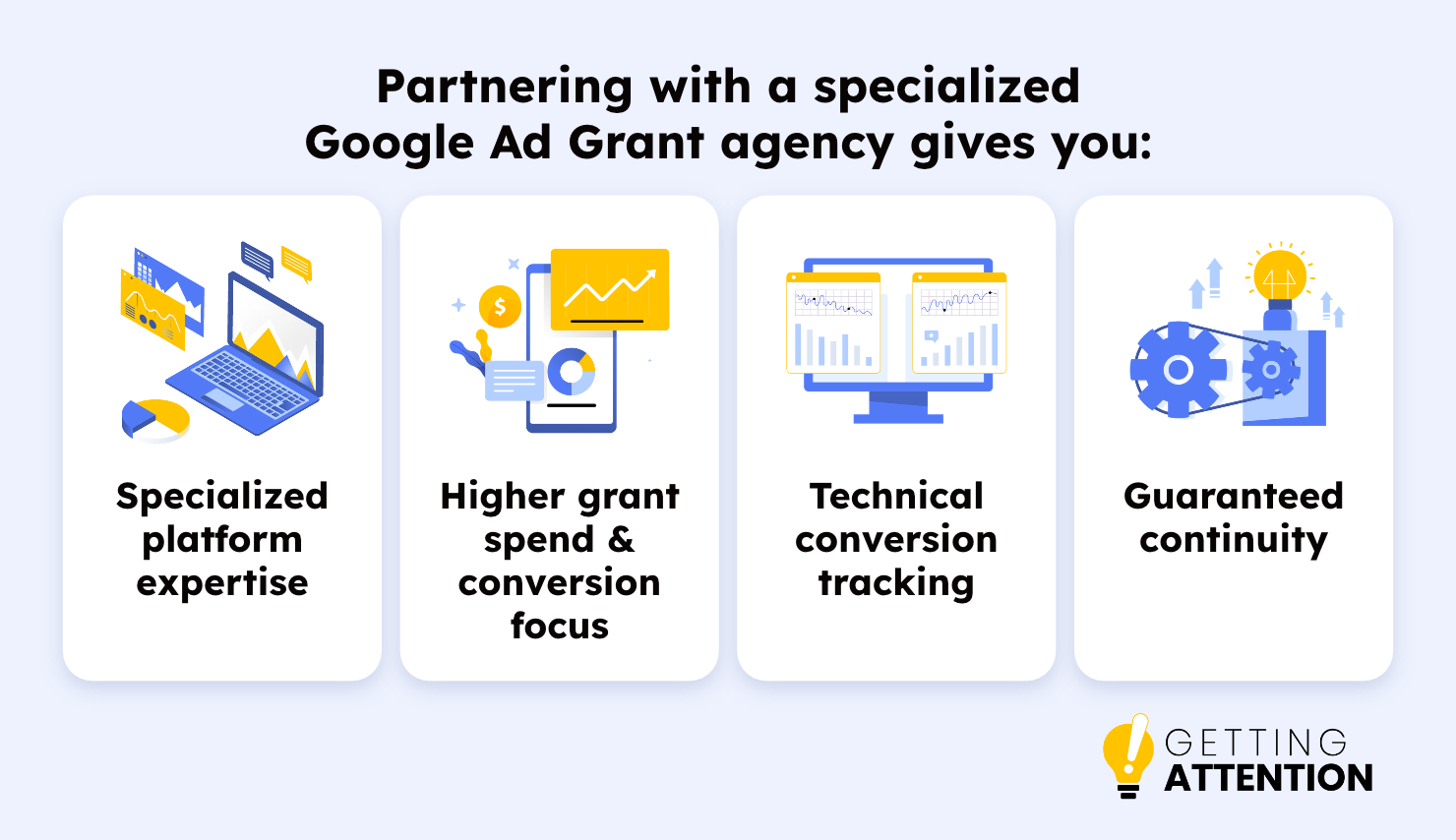
Here are areas where agencies add the most:
- Specialist knowledge. Grant management is a specialty. Agencies handling many accounts through policy changes, pauses, and reinstatements can spot and fix issues before they become costly. For instance, our team at Getting Attention is a certified Google Partner, and our former Google staff manage dozens of grant accounts. This experience helps us catch policy changes early and solve problems you may encounter.
- Fuller budget use. Specialists know how to structure campaigns so monthly spend can safely climb toward the full $10,000 limit without wasting the budget on junk. The goal is clicks that turn into donations, sign-ups, and volunteer leads, not just traffic that looks good in a report.
- Tracking that connects to outcomes. An agency sets up GA4 and conversion goals properly from the start. That means leadership can see exactly what the grant is producing, such as how many donations or volunteer leads came through, instead of guessing at the return.
- Continuity. The agency takes responsibility for keeping your account active and compliant. If a staff member leaves, the logins, tracking notes, and campaign logic don’t leave with them, so the account never sits unmanaged while a replacement gets up to speed.
How to plan for a specialized agency management partnership
Hiring an agency takes work off your plate, but it works best as a partnership. A little preparation up front and steady communication afterward make the difference between an account that sounds like your organization and one that feels generic.
Keep the following considerations in mind when prepping for your partnership:
- Onboarding takes a few weeks. The agency needs your brand guidelines, program priorities, donor profiles, and access to GA4 and Tag Manager. Also consider that Google needs about a 30-day learning phase for ads to begin getting results. It’s important to have realistic expectations of what to expect.
- You still own the story. Agencies can’t know about a new program or a gala date unless you tell them, so expect a monthly review call (ours run 30 minutes) and quick replies when they need approval.
- Fit for ongoing work. Agencies are typically best to run the entire system for you from the start to the ongoing optimization phase. If you want a one-time setup or occasional coaching to run the account yourself, a training provider or consultant is a better fit.
Questions to ask any agency before you sign
Agencies vary a lot in how they work. These questions help you compare options on what will matter once the account is live.
- Who will work in my account, and how many other nonprofits do they manage? A dedicated specialist with a manageable account load beats a rotating team.
- How do you measure success? Look for answers built around conversions and return on investment instead of simple ad spend.
- Are you a Google Partner, and is the Ad Grant a core service? Specialists know the grant’s quirks. Add-on service providers at generalist marketing agencies often don’t.
- What does reporting look like between calls? An always-on dashboard plus a monthly report means you never wonder what’s happening in the account. Ideally, it’s also easy to get in touch, whether via email or on a call, whenever a question or request might pop up.
- What happens if the account gets suspended? A good answer includes an audit, a corrective plan, and direct contact with Google.
- What does the fee cover, and what costs extra? Content, paid ads, and tracking work sometimes sit outside the base price.
The right agency will answer these questions plainly and without hesitation. Pay attention to how specific the answers are: names, numbers, and examples from real accounts indicate real, lived experience. If the answers leave you feeling informed (and maybe a little relieved!), you’ve probably found a partner who will treat your grant like their own work. If they stay vague, keep looking, because the account you’re handing over is free advertising worth up to $10,000 a month.
In-house vs. agency management: Side-by-side comparison
Once you know what an agency expects from you and what to ask them, it helps to see how the two models compare on the factors that affect results most. The table below puts them next to each other:
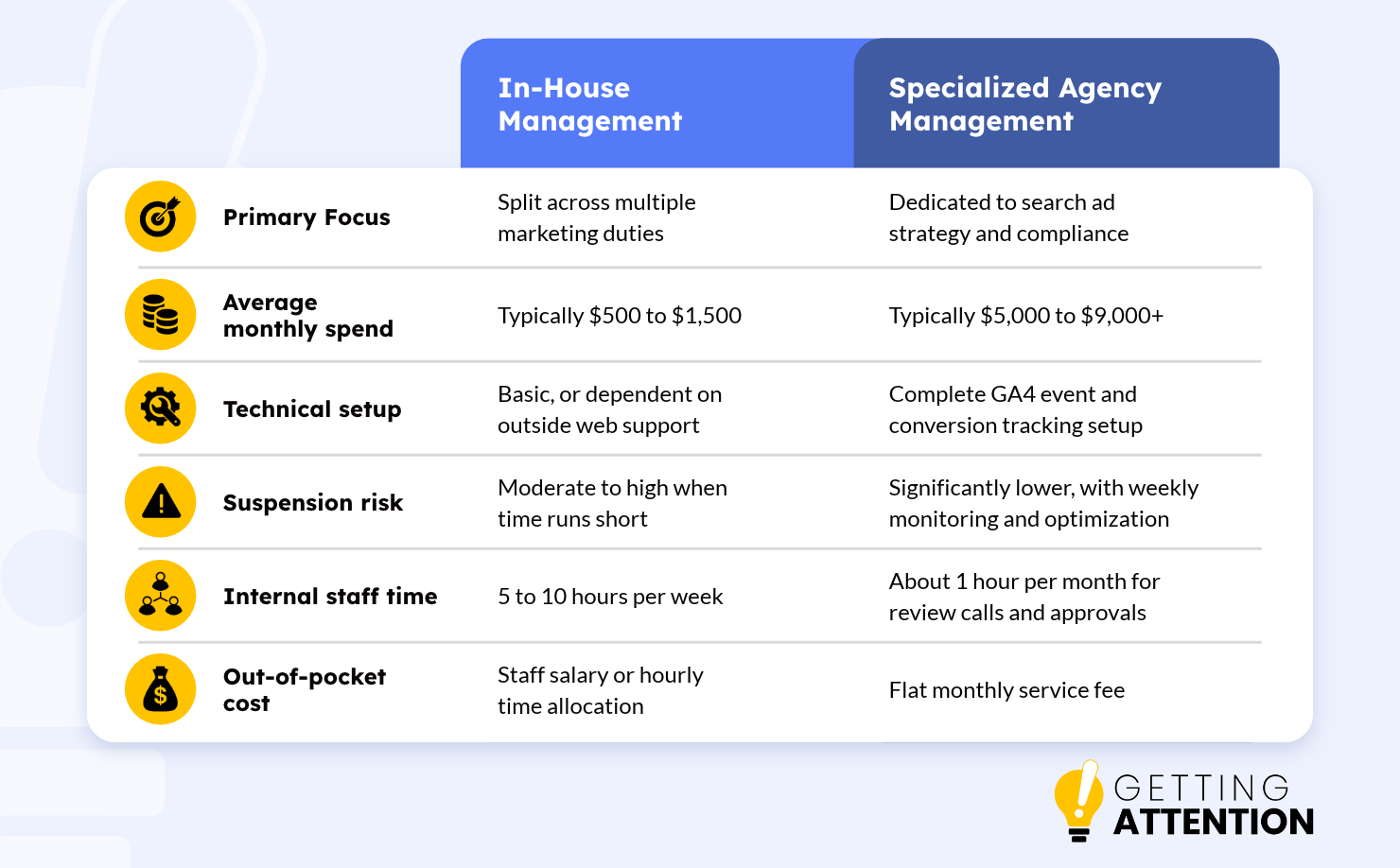
The better fit comes down to what your team can protect: if you have a person with the specific skills and the hours to own the grant, in-house can work well. If those hours keep getting pulled toward other priorities, an agency can help you put more of the ad credit to use, set up conversion tracking you can trust, and create an account workflow that doesn’t depend on one person.
Which route should you choose?
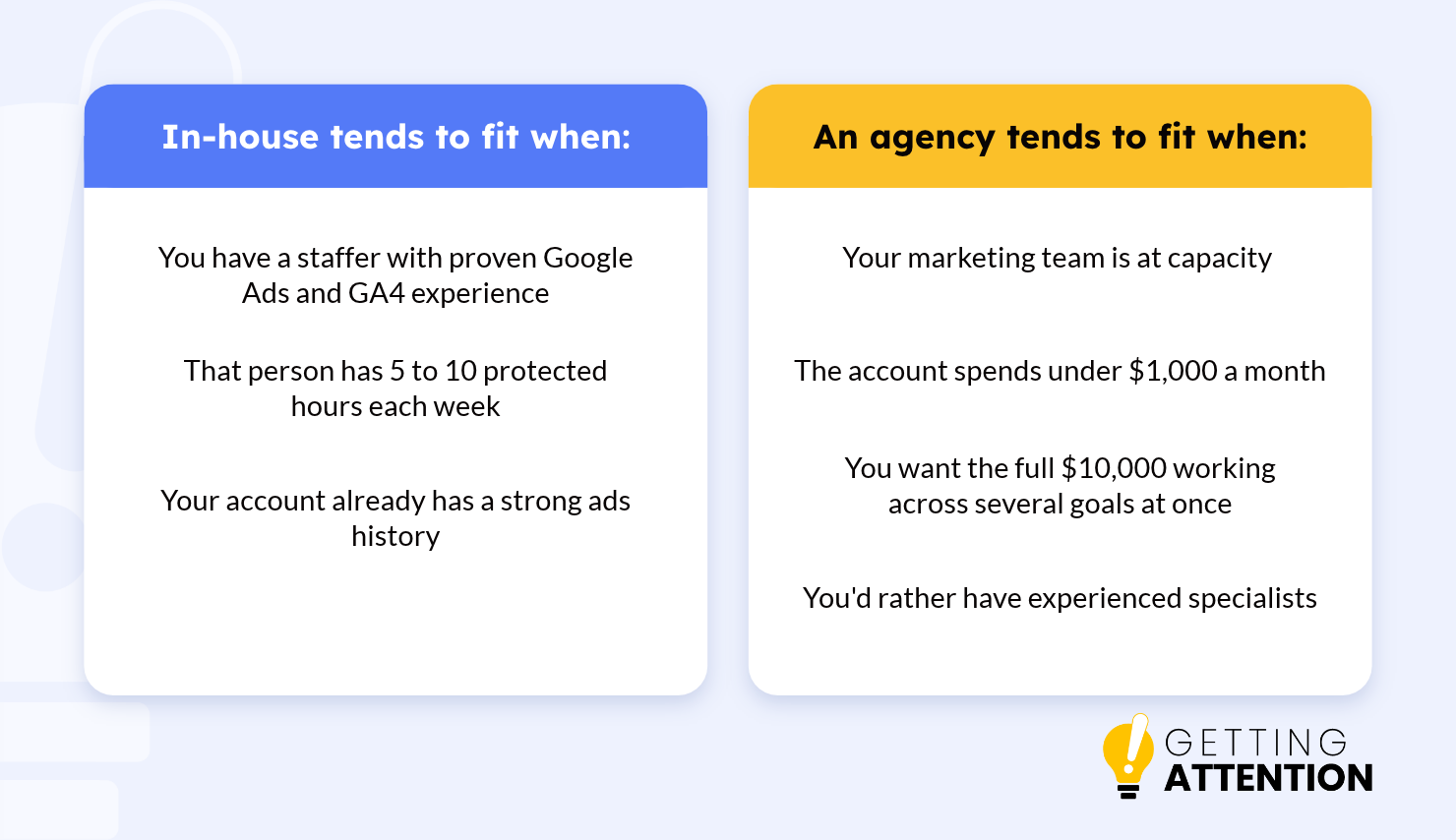
In-house Ad Grant management tends to fit when:
- You have a staffer with proven Google Ads and GA4 experience, ideally with Ad Grant history.
- That person has five to 10 protected hours each week, and a trained backup covers vacations and sick days.
- Your account already has a strong ads history and spends most of its monthly budget, which is the best sign the current setup works.
An Ad Grant management agency tends to fit when:
- Your marketing team is at capacity or is inexperienced with the Google Ad Grant and can’t take on a technical, weekly task.
- The account spends under $1,000 a month, has been suspended, or hasn’t been touched in months.
- You want the full $10,000 working across several goals at once, including donations, volunteer recruitment, resource downloads, and event sign-ups.
- You’d rather have experienced specialists, like the former Google employees on our team, handle setup, keyword targeting, bidding, and monthly reporting.
How we manage your Google Ad Grant
At Getting Attention, we provide strategic, conversion-focused Google Ad Grant management for growing nonprofits. As a certified Google Partner agency staffed by former Google employees with 5+ years of direct ad experience, we handle the entire lifecycle of your Ad Grant for a flat rate of $600 per month (with no hidden setup fees or spend percentages).
Our full-service Ad Grant management includes:
- Dedicated Ad Grant Specialist: You get a single, consistent account manager responsible for your campaign performance, compliance, and strategy. Our specialists are former Google employees who understand platform mechanics behind the scenes and stay with your account long-term to prevent disruptions.
- Google Ad Grant Application: We verify your Google for Nonprofits status, review your website for compliance, and submit your grant application properly. We maintain a 100% application approval success rate across all submitted accounts.
- Google Ad Grant Reactivations: If your account has lapsed, underperformed, or been suspended due to policy violations, we handle the full remediation process—including audits, corrective action plans, and direct communication with Google Support to reinstate your funding.
- Campaign creation: Before writing copy, we research search intent, competitor visibility, and landing page alignment. We build structured, tightly themed campaigns that mirror how donors, volunteers, and beneficiaries actually search online.
- Monthly live reporting: You receive 24/7 access to an on-demand Google Data Studio dashboard, a transparent monthly performance report connecting ad metrics to real outcomes, and a monthly 30-minute video review call with your dedicated specialist.
- Ongoing Ad Grant Account Optimization: We review and refine campaigns weekly to protect compliance and improve performance. Key optimization activities include:
- Search term reviews: Analyzing real search queries to add negative keywords and build new ad groups around high-intent searches.
- Ad refreshes: Testing new headlines and descriptions to maintain high Quality Scores.
- Conversion tracking creation and testing: Implementing and validating tracking for donations, volunteer forms, event RSVPs, and newsletter sign-ups.
- Ad policy & compliance reviews: Monitoring policy shifts and account health to maintain the 5% CTR threshold and proper account architecture.
- Keyword quality checks: Evaluating keyword relevance and landing page alignment to keep Quality Scores strong.
We manage Ad Grant accounts across a range of causes, including arts and culture, animal welfare, health and wellness, environmental, and education and literacy nonprofits. Whatever your sector, we handle the application, campaigns, compliance, and reporting, so your account gets specialists who already know how your supporters search.
Our results for managed Ad Grant accounts
Across the accounts we manage, nonprofits typically see click-through rates 25% or more and 200% or more click growth once campaigns are optimized. Here are some proven results of our Google Ad Grant Management:
- The IgA Nephropathy Foundation had used the grant for five years without conversion tracking or much structure in place. After a rebuild around responsive search ads and Performance Max, the account added 1,616 clicks and 1,687 conversions, including downloads of key patient resources.
- Before working with Getting Attention, clicks to Erika’s Lighthouse came mostly from people looking for counseling, which the nonprofit doesn’t offer. Negative keywords and tighter targeting of teachers, social workers, and school administrators lifted CTR to 9.59% and produced 123 new accounts.
- Conversion tracking at MCA Denver had been set to page views only. Once tracking was expanded to include ticket purchases, memberships, email sign-ups, and shop visits, the account gained 2,933 conversions and 109% more clicks, with an estimated ROI of 154.56%.
- With a small team and little time for the account, Diabetes Youth Families went from 43 to 192 monthly conversions after working with Getting Attention. CTR reached 10.91%, cost per conversion dropped from $41.93 to $16.67, and monthly grant spend climbed more than 3,000% from under $100.
Each of these accounts had a different problem: missing conversion tracking, clicks from the wrong audience, tracking set to page views only, and a team with no time to manage it. They needed a specialist who could spot the specific issue and fix it. That’s the advantage of specialization: pattern recognition built across many accounts shortens the path from a stalled grant to measurable results.
If any of these stories sound like your account, a free audit is a low-pressure way to see what’s holding it back. Our team can show you where the gaps are and what fixing them could look like.
Frequently asked questions
What is the true cost of managing Google Ad Grants in-house versus hiring an agency?
In-house management costs five to 10 staff hours weekly plus the hidden expense of unused ad credits, whereas hiring an agency costs a predictable flat fee (like $600/month) to unlock the full $10,000 allowance. You’re trading internal bandwidth and suspension risks for guaranteed expertise and maximized search reach.
What happens if our Google Ad Grant is suspended for non-compliance?
Your ads freeze immediately, and you lose free search traffic, but your grant isn’t lost forever! A specialized team can run a compliance audit, fix broken account structures or low CTRs, and submit an appeal to Google to reactivate your $10,000 monthly credit fast.
Will an agency actually spend our full $10,000 monthly budget?
Yes, specialized agencies routinely scale spend toward that $10k ceiling—our clients average $8,650/month—using broad keyword structures, smart bidding, and responsive ad copy. While in-house teams often stall under $1,000, professional management squeezes every drop of value out of your grant.
How long does it take for an agency to take over our existing in-house account?
Transferring your account takes just 1 to 2 weeks with zero downtime for your active ads. The agency conducts a swift account audit, hooks up GA4 conversion tracking, aligns with your mission goals, and revitalizes your campaigns without interrupting your ongoing search presence.
How do we maintain ownership and control of our accounts if we hire an external team?
You should retain 100% administrative ownership of your Google Ads, GA4, and Google for Nonprofits accounts at all times. Typically, this will involve connecting to the agency’s MCC account. This specialized account type lets the agency work without kicking you out, meaning you can inspect campaigns, review ad copy, or revoke permissions whenever you want—you’re always in total control.
What specific technical skills does our internal team need to manage the grant ourselves?
Your team needs hands-on proficiency in Google Ads keyword research, negative match modeling, GA4 and Google Tag Manager conversion event tracking, responsive ad copywriting, and Google’s mandatory 5% CTR compliance rules. Without these technical skills, accounts frequently underperform or face suspension.
Choosing the path that fits
The Google Ad Grant offers up to $120,000 a year in free search advertising, but only an account that stays compliant, tracks real outcomes, and uses its full budget delivers that value.
Before you decide, pull three numbers from your account: last month’s account-level CTR, the share of the $10,000 you spent, and the number of conversions tied to a real action like a donation or sign-up. If CTR is strong, you’re spending most of your credit, and your conversions map to outcomes you care about, your in-house setup is working. Your next step is protecting it with a backup owner and a written weekly routine. If one or more of those numbers is off and nobody has the hours to fix it, pricing out an agency is worth the conversation.
Once your grant account is on solid footing, these resources can help you reach supporters beyond search:
- Google Ads vs. Meta Ads: The definitive guide for nonprofits: Compare both platforms side by side to decide where your next ad dollar should go.
- How to optimize for AI Overviews: A guide for nonprofits: Rewrite the opening of your top program page this week so AI search tools can quote it.
- The ultimate Meta Ads guide for nonprofit organizations: Set up your account and launch one small test campaign to find supporters who aren’t searching yet.