A nonprofit’s guide to the technical SEO audit checklist
Last Updated on September 25, 2026
What if the biggest barrier between your nonprofit and your next major donor isn’t your messaging, but your website’s hidden code? Nonprofits are missing out on vital donations, volunteer sign-ups, and Google Ad Grant resources because their websites have invisible technical barriers preventing search engines from reading them. Most nonprofit marketing teams are stretched incredibly thin, and dealing with “technical SEO” feels like an overwhelming IT project that diverts time away from the mission.
Technical SEO doesn’t require a computer science degree; a straightforward, nonprofit-focused checklist can help teams identify and fix crawlability, indexing, and on-page issues. By taking a methodical approach to these technical foundations, your organization can permanently remove the roadblocks keeping search engines at bay. This ensures your mission reaches the exact people searching for ways to support your cause.
In this article, we’ll walk through a straightforward, nonprofit-focused checklist so your team can work through crawlability, indexing, and on-page issues one step at a time
Table of contents:
- What is a technical SEO audit?
- Why is technical SEO important for nonprofit websites?
- How long does a technical SEO audit take?
- What is the difference between technical SEO and on-page SEO?
- How often should a nonprofit conduct a technical SEO audit?
- The essential technical SEO audit checklist
- Elevate your website with technical SEO services

What is a technical SEO audit?
A technical SEO audit is a comprehensive diagnostic process that evaluates a website’s backend infrastructure. It identifies errors related to crawlability, indexability, site architecture, and speed that prevent search engines like Google from properly reading, categorizing, and ranking your pages.
- Understanding technical foundations: An audit reveals invisible barriers holding your site back from top search results. Nonprofits often pour significant resources into storytelling campaigns that ultimately fail to gain traction. These campaigns stall simply because broken backend code prevents search engine crawlers from finding them. Finding these errors reopens the door to organic traffic.
- Evaluating crawlability: Search engines, and increasingly, other search methods like AI tools, need to be able to discover and read your pages without hitting structural roadblocks. If your server blocks essential pathways, automated bots simply leave your site. This abandonment means your latest donation appeals never appear in public search queries. Clear pathways guarantee maximum visibility.
- Assessing indexability: Make sure that search engines actually store the pages they discover in their databases so they can display them in search results. Finding a page represents only half the battle. If faulty tags tell search engines to ignore your content, they will never file it away for users to find later. Proper indexability secures your place in the search engine library.
Before diving into manual code reviews, we recommend connecting your website to Google Search Console to establish a baseline of current indexing errors. This free platform flags your most critical structural blockages immediately, allowing your team to tackle the highest-impact fixes first rather than guessing where problems lie.
Why is technical SEO important for nonprofit websites?
Technical SEO is vital for nonprofit websites because it ensures search engines can discover and display your mission to potential donors and volunteers. Without a sound backend foundation, even your most compelling content remains invisible, severely limiting your digital reach and even your compliance with Ad Grant requirements.
Addressing these technical foundations provides several key benefits for your nonprofit:
- Securing Google Ad Grants: A healthy, compliant website is a strict requirement for using Google Ad Grant funding. Google actively suspends accounts associated with slow, broken, or poorly structured websites. Routine maintenance of your technical infrastructure safeguards this massive monthly advertising budget. Do not risk losing $120,000 in free annual funding over preventable errors.
- Maximizing digital impact: Removing technical barriers directly correlates to increased donations and volunteer sign-ups. Technical SEO helps website pages rank better, leading to higher engagement and conversion rates. When pages load instantly and function flawlessly, frustrated users stop abandoning your donation forms. Smooth user journeys multiply your digital conversions.
- Protecting limited resources: Fixing backend errors ensures your existing content marketing efforts do not go to waste. Technical SEO helps improve user experience, emphasizing web accessibility. Your marketing team works too hard on blog posts and impact reports to let bad code bury them! Functional digital infrastructure maximizes the return on your content investments.
Fast load times and seamless navigation signal organizational competence and reliability, which improves user trust. Visitors feel inherently safer submitting payment information on a lightning-fast, error-free platform.
How long does a technical SEO audit take?
A technical SEO audit typically takes one to two weeks to complete, depending on the size and complexity of the website. Identifying the core crawlability and indexing errors requires a few days, while analyzing and prioritizing the fixes takes additional time for strategic planning. Huge databases demand more processing time. Smaller sites finish much faster. Here’s what a complete technical SEO audit is typically composed of:
- Initial diagnostic phase: Running crawlers and identifying core issues usually requires a few days to a week. During this window, software bots systematically scan every single URL attached to your primary domain. They log problems like slow load times, broken internal links, and misconfigured redirects.
- Strategic prioritization: Your diagnostic phase will likely surface hundreds of problems on the site. It’s easy to get overwhelmed, but not every issue needs to be fixed right away or with the same level of urgency! An outdated team bio or a missing image is lower priority than a core program page caught in a redirect loop. We recommend creating a plan to address the issues surfaced, prioritizing them by their potential impact on donations and other conversions and organic traffic.
- Implementation timeline: Applying the fixes depends entirely on your team’s bandwidth or your agency partner’s speed. Simple metadata updates might take a junior marketer just a few hours. Complex server-level redirect chains might require your web developer to work for an entire month.
Don’t let technical hurdles slow down your mission. Schedule a free consultation with our team today to discover how we can help you fix issues proactively, accelerate your website’s performance, and maximize your impact.
What is the difference between technical SEO and on-page SEO?
Technical SEO focuses exclusively on backend website infrastructure, ensuring search engines can successfully crawl and index pages. On-page SEO involves optimizing the visible content and HTML source code, such as keyword placement and headings, to ensure the pages are highly relevant and valuable to users.
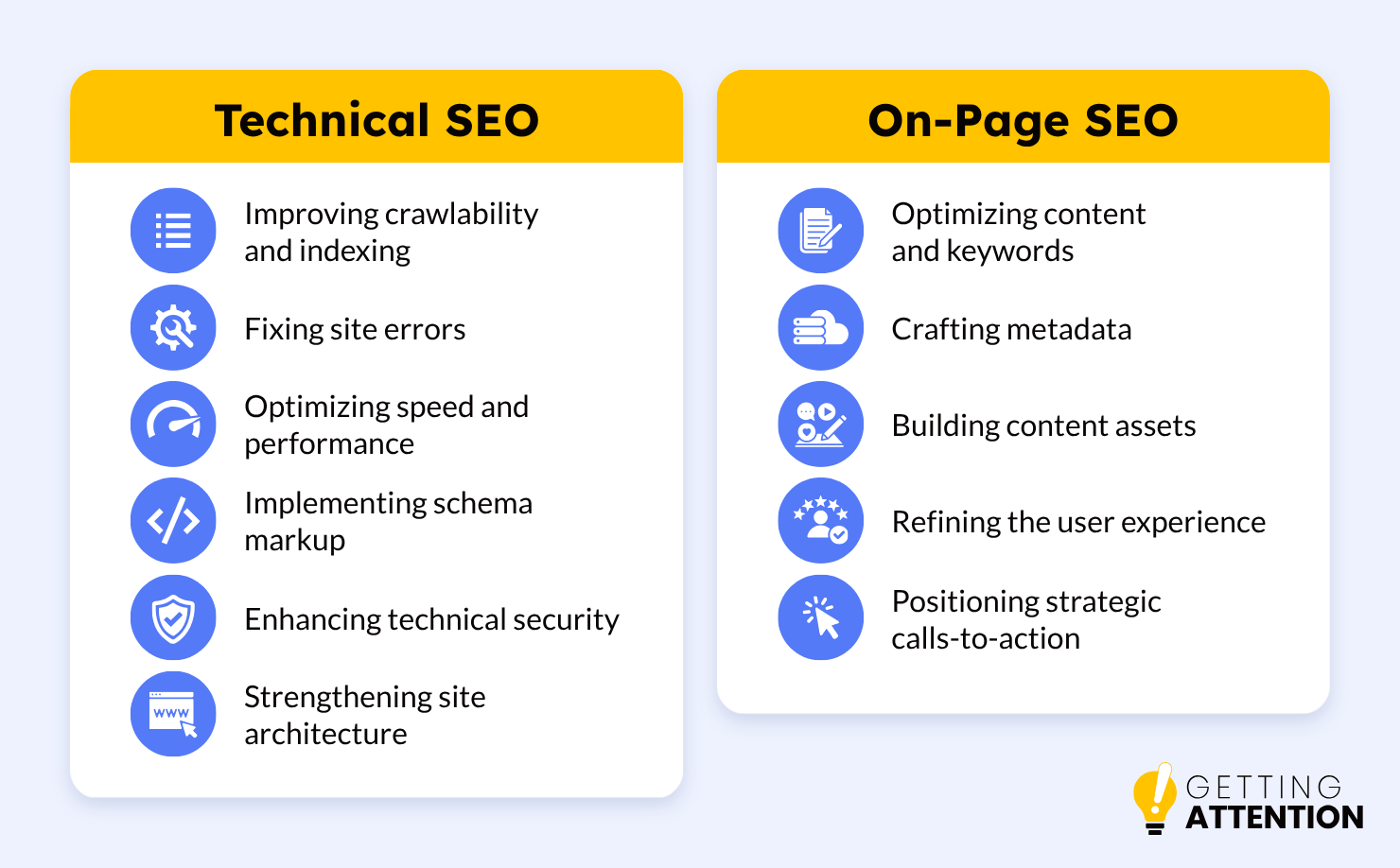
- Backend infrastructure focus: Technical optimization deals with site architecture, redirects, and server-side elements. It handles the highly complex communication happening between your website server and Google’s crawling bots. This process rarely involves front-end facing work like writing or graphics. It handles performance metrics and how information moves between computers across the internet.
- User-facing optimization: On-page strategies revolve around keyword placement, heading structures, and content quality. This process requires audience empathy and compelling copywriting skills to engage human readers, in addition to a clear understanding of how Google and other bots will parse content.
- Working in tandem: Great on-page content cannot rank if technical barriers prevent search engines from finding it. Conversely, perfectly accessible code will fail to rank if the visible elements on the page like text, graphics, and videos offer zero value to the reader. You need both to reach that coveted page 1 spot in Google Search results!
Always address technical roadblocks before launching any on-page content overhauls. Writing effective, keyword-rich blog posts on a website that blocks search engine indexing wastes time and money. Secure the technical foundation first, then pour your energy into creating high-quality, optimized narrative content.
<h2=often>How often should a nonprofit conduct a technical SEO audit?
Nonprofits should conduct a comprehensive technical SEO audit at minimum once a year, but ideally every six months. You should also perform immediate technical audits following major website redesigns, CMS migrations, or significant drops in organic search traffic.
- Bi-annual checkups: Regular audits catch minor issues before they become major problems. Your staff may be regularly adding new pages, deleting old forms, and accidentally creating redirect chains. Checking the foundation every six months sweeps up this natural digital clutter.
- Post-migration reviews: Before migrating a CMS or doing a major overhaul, we recommend creating a map for the new site. Always audit your site immediately after a redesign to catch broken links or lost redirects. Moving a website to a new platform can drastically alter the underlying URL structures. Failing to map old URLs to new destinations can destroy years of accumulated search authority.
- Routine monitoring: Use automated tools to monitor site health between major manual audits. Software can alert your team the moment a critical page suddenly drops from the search index. This active monitoring allows you to fix urgent page issues before they impact major initiatives. We recommend Google Search Console as a great starting place for this, but there are plenty of other options either free or paid.
To keep technical maintenance manageable, consider setting up a weekly dashboard to monitor key metrics like crawl errors and core web vitals. Staying proactive prevents small issues from snowballing into major traffic drops. Before requesting a full site evaluation, review the checklist below to address the core areas that impact your search visibility.
The essential technical SEO audit checklist
The essential technical SEO audit checklist reviews crawlability, indexation, site architecture, link health, metadata, and Core Web Vitals. By systematically evaluating these elements, nonprofit teams can ensure search engines access, understand, and rank their mission-critical pages without requiring advanced coding knowledge.
Here are the critical areas your technical SEO audit must address to secure your website’s performance:
Crawlability and indexation
- Robots.txt configuration: Verify that your file isn’t accidentally blocking search engines from crawling important donation or volunteer pages. A single misplaced keystroke in this tiny text file commands Google to completely ignore your primary fundraising hubs. Developers often use block commands during redesigns and forget to remove them upon launch.
- XML sitemap accuracy: Ensure your sitemap is submitted to Google Search Console and only contains indexable URLs without redirect chains. Think about the size of the internet – Google and other search engines don’t have the bandwidth to crawl every single page, so they consult the sitemap to quickly understand where they should go to best map out the content on the site. Including deleted or blocked pages confuses the bots and wastes your valuable crawl budget.
- Noindex tag review: Even if your robots.txt and sitemap are functioning properly, individual pages can still tell Google “stay away.” Check that critical pages aren’t mistakenly hidden from search results due to leftover development tags. Scanning your source code for these tags guarantees your best content actually has the chance to vie for a spot in the rankings.
Site architecture and internal linking
- Site architecture depth: Page depth refers to how easy it is to get to a page from the homepage, which Google views as an indication of that page’s importance. Ensure all critical mission pages like program descriptions, donation pages, and volunteer signup pages are accessible within three clicks from your homepage. Deeply buried pages signal to search engines that the content holds little structural importance. If visitors have to dig through five sub-menus to find your volunteer application, search bots (and potentially users!) will likely abandon the journey entirely.
- Orphan page identification: An orphaned page is a single, isolated page with no way to access it, meaning whatever is on it is likely invisible both to your users and to crawlers. Search engines discover new content primarily by following internal links from established pages. Find and link isolated pages that lack internal connections to increase their visibility to search engine crawlers. Make sure you’re being systematic – pages should be linked to each other in a logical fashion to easily guide users and bots. One exception to the orphaned page rule? Thank-you pages or other confirmation pages that users should only reach if they’ve successfully completed an action like donating or signing up.
- Descriptive anchor text: Use clear, relevant anchor text (the text that contains links on your web page) instead of generic phrases to help search engines understand page context. Linking the phrase “click here” provides zero contextual clues about the destination page’s actual topic. Changing that link to “view our animal rescue impact report” explicitly tells the algorithm exactly what to expect.
Link health and redirects
- Link health maintenance: Regularly identify and fix broken internal and external links. Clicking a hyperlinked resource only to hit a 404 error page halts the user experience. Search engines actively penalize websites that force users into these frustrating dead ends.
- Redirect management logic: Implement proper 301 (permanent) redirects for deleted or moved pages to preserve link equity. When you delete an outdated campaign page, any external websites linking to it suddenly point nowhere. A permanent 301 redirect forces that traffic to a newer, highly relevant page.
- Eliminating redirect chains: Sometimes pages go through multiple updates, leading to redirect after redirect. Update your links to point directly to their final destination to conserve crawl budget and improve load speeds. Forcing a browser to bounce through four different URLs before finally loading the actual content lags performance. Search engine bots frequently abandon chains that stretch too far.
Metadata and performance
- Metadata optimization: Ensure every page has a unique, descriptive title tag and meta description. These backend text snippets influence the highly visible blue links and black descriptions displayed directly on Google search result pages. Using identical tags across 50 pages of your website prevents your resources from standing out, and risks Google making creative (read: bad) choices about what to show instead.
- Mobile responsiveness: Confirm that the website functions perfectly on mobile devices, as search engines prioritize mobile-first indexing, since most internet activity happens on cell phones. The majority of your potential donors now navigate your website exclusively using their smartphones. If your text shrinks and buttons overlap or jump around on small screens, algorithms will actively suppress your rankings.
- Page speed metrics: Monitor Core Web Vitals like Largest Contentful Paint (LCP) and First Contentful Paint (FCP) to guarantee fast loading times for your users. These metrics are a measure of how long it takes for the biggest and first piece of content on your page, respectively, to load. Heavy, uncompressed hero images or videos can force your website to load at an agonizingly slow pace. According to a Google study, impatient visitors typically abandon sites that take longer than 3 seconds to fully render.
Search engine algorithms evolve constantly, placing new demands on site speed and security protocols. Review these checklist items quarterly with your web development team to ensure your infrastructure can handle whatever technical updates search engines roll out next.
Elevate Your Website with Technical SEO Services
Your nonprofit’s website is the foundation of your digital presence. However, even the most inspiring mission will not drive real-world impact if search engines cannot easily navigate your site architecture. That is precisely why Getting Attention offers dedicated Technical SEO Services. This specialized service ensures your website is fully optimized under the hood. By fixing the backend, your organization can maximize its organic visibility, build long-term sustainable growth, and reach far more supporters online.
What’s included in Getting Attention’s Technical SEO Services
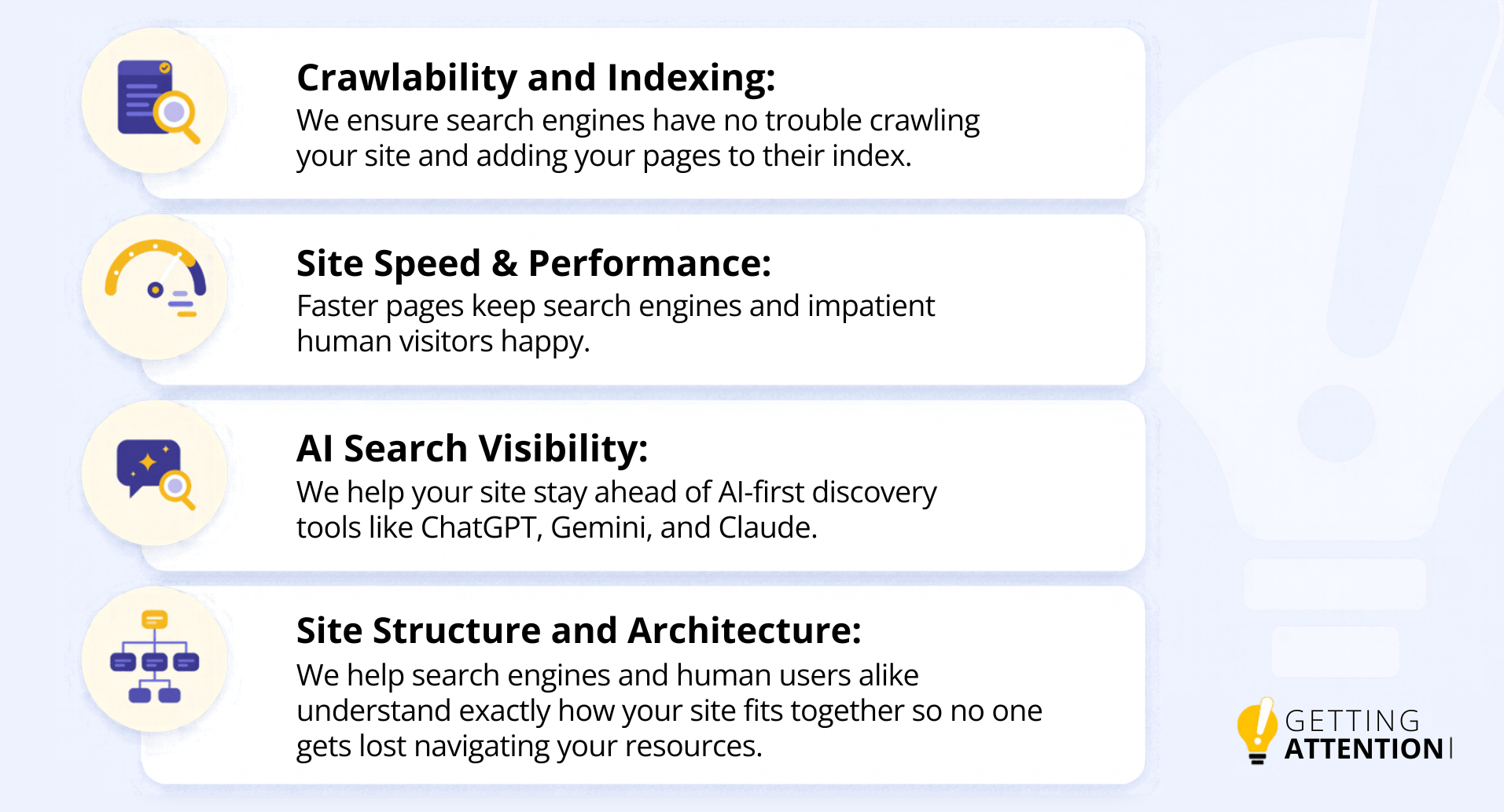
At Getting Attention, we partner directly with you to turn your digital marketing potential into measurable growth using a proven, hands-on approach. Our global team of dedicated experts strengthens your site’s foundation so your nonprofit can be easily found by the right people. We ensure your technical infrastructure is fully optimized by focusing heavily on four key areas:
- Crawlability and Indexing: We ensure search engines have no trouble crawling your site and adding your pages to their index. We start the process with an indexing audit and review your XML sitemap and robots.txt file to ensure your settings aren’t blocking automated discovery tools. Simultaneously, we resolve any duplicate content issues that might confuse crawlers and dilute your ranking potential.
- Site Speed & Performance: Faster pages keep search engines and impatient human visitors happy. We improve your website’s overall speed by compressing and optimizing heavy images, implementing lazy loading, and making other essential Core Web Vitals improvements.
- AI Search Visibility: We help your site stay ahead of AI-first discovery tools like ChatGPT, Gemini, and Claude. We ensure AI tools can read and cite your site accurately by actively adding an llms.txt file, keeping all content in readable code, and maintaining consistent organizational facts across your domain. Your future supporters are already using AI to search – we help you meet them there and stay ahead of the curve.
- Site Structure and Architecture: We help search engines and human users alike understand exactly how your site fits together so no one gets lost navigating your resources. This structural work involves implementing logical URL pathways, cleaning up confusing navigation menus, deploying a smart internal linking strategy, and adding rich schema markup so AI-powered search engines easily understand your specific content.
With our technical expertise backing your mission, you ensure your website’s foundation stands fully equipped to drive high-value actions for your cause. You can see exactly how our website and digital expertise drive real-world results by exploring our success stories.
Wrapping Up
Your nonprofit’s website is one of the main drivers of your digital marketing and fundraising success. By addressing technical SEO barriers, you ensure your mission is visible, accessible, and ready to convert curious supporters into donors. Consistent maintenance and proactive auditing are the keys to sustained digital growth.
To help you turn into the ultimate nonprofit marketer, explore these additional resources:
- How to Build, Grow, and Get Your Nonprofit Website Found Online: Your website is the digital face of your mission. Learn how to optimize it for maximum impact.
- 6 Steps to Hire an Excellent Nonprofit Marketing Consultant: Sometimes, external expertise is the missing piece of the puzzle. Discover how a consultant can accelerate your strategy.
- Create a Winning Nonprofit Marketing Plan in 8 Key Steps: A solid plan keeps your mission moving forward. Use this resource to structure your growth roadmap.