Best Practices for Nonprofit AI Search Engine Optimization
Last Updated on September 30, 2026
The days of a simple Google Search are over. Instead of scrolling through search engine results, people increasingly ask AI chatbots complex questions and form their views based on the conversational, personalized responses they receive. Pew Research reports that as of 2025, 64% of US teens, the next generation of donors and volunteers, reported using AI chatbots for research and information gathering. While this method of searching is arguably more aligned with users’ requests, it means that if your nonprofit is absent in the AI summaries of your field, you lose visibility among potential new supporters.
Luckily, there’s a large amount of overlap between generative engine optimization (GEO) strategies and traditional search engine optimization (SEO) techniques. The highly structured, fact-dense website content required to appear in AI overviews directly boosts your website’s rankings in traditional search engine results and improves your overall website authority. This guide highlights a few proven ways to increase your AI visibility and connect with supporters through GEO strategies. Let’s get into it!
Table of Contents:
- AI Search Engine Optimization FAQs
- How to develop a structured AI search optimization strategy
- Outsource your strategic planning
- About Getting Attention’s AI optimization services
AI Search Engine Optimization FAQs
What is AI Search Engine Optimization?
AI search engine optimization, or Generative Engine Optimization (GEO), is a method for structuring your digital content to improve compatibility with large language models. Effective GEO techniques, such as emphasizing dense facts, direct answers, and technical crawlability, train AI to recommend your organization.
In addition to increasing your visibility in AI search tools, GEO strategies can improve your standing in general search engine results. This means that a single, comprehensive update to your current SEO strategy to incorporate GEO best practices can improve your traffic with both AI summaries and traditional SERP results.
What are the benefits of a structured AI Optimization Strategy?
A structured optimization framework provides a clear policy for improving your organization’s AI engine visibility that your team can apply across your digital offerings.
AI optimization strategies benefit your organization in the following ways:
- Increasing visibility in AI Summaries: AI-generated results dominate the top of most search engine results pages. An AI-optimized content structure improves your chance of being cited in these summaries and establishes your nonprofit as an authoritative voice in your field.
- Boosting brand authority and citations: AI search engines (like Perplexity or Google’s AI Overviews) prioritize high-quality, structured sources to ground their answers. Optimized content featuring quotations and recent statistics is more frequently cited as an authoritative source and linked in AI search results and summaries, driving traffic to your site.
- Improving dual audience experience: Tactics that help AI models quickly crawl and understand your content, such as clear headings, bulleted takeaways, and upfront summaries, also improve the reading experience for your human audience.
- Future-proofing digital presence: As user behavior continues to trend toward AI-driven research, a clear AI search optimization strategy helps you continue to find new supporters as technology evolves.
What are the Best AI Optimization Strategies for Nonprofits?
Like traditional SEO practices, your nonprofit can use proven techniques to boost your likelihood of appearing in AI search results.
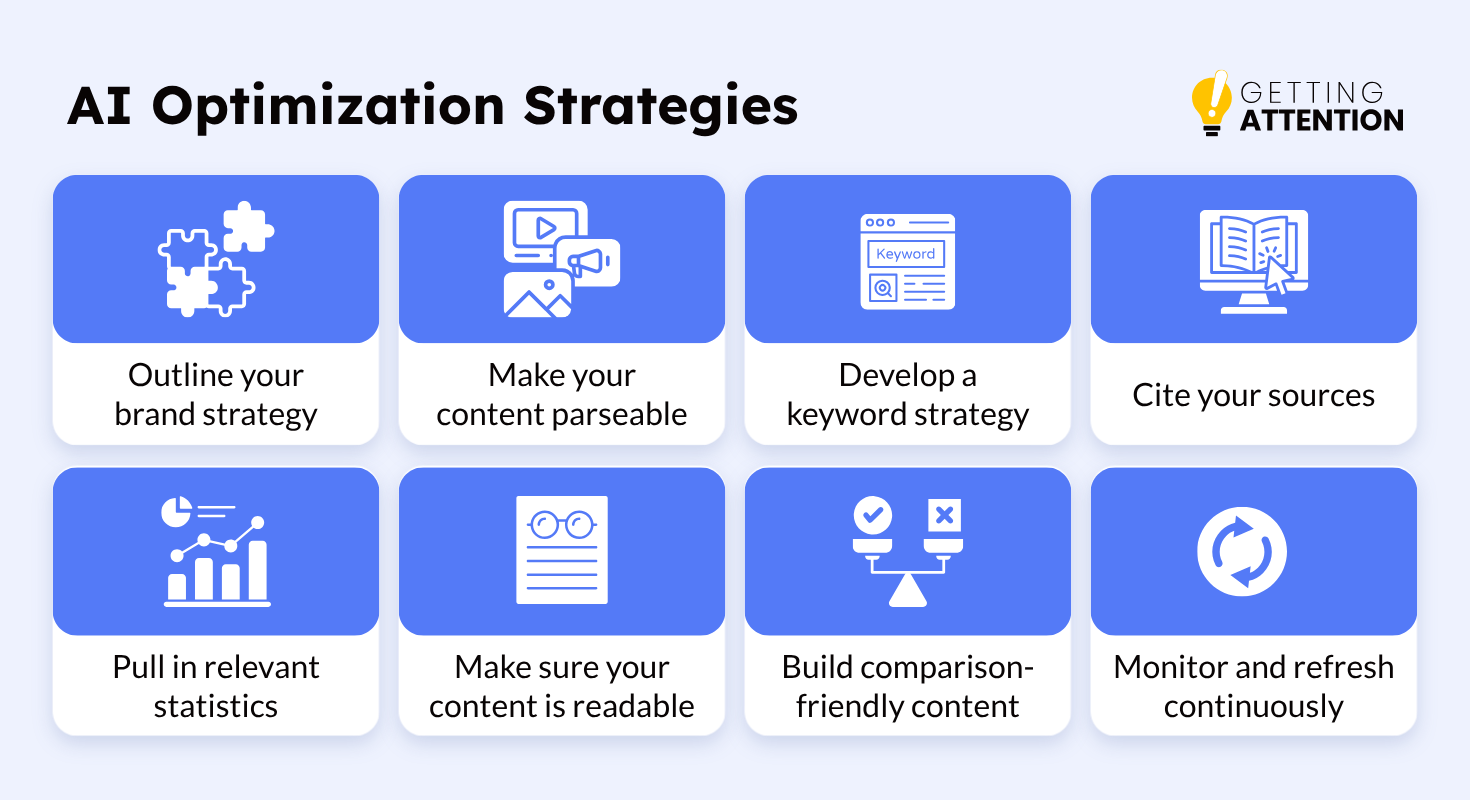
These simple tips can improve your likelihood of appearing in AI search results:
- Outline your brand strategy: Explicitly define your nonprofit’s brand and the exact problems you solve so AI systems understand precisely when and to whom they should recommend your organization. A designated LLM page is a great way to include this information unobtrusively.
- Make your content parseable: Include easily crawlable features, such as FAQ sections, How To pages, and detailed services data, to increase your chances of being cited in an AI Overview. Technical SEO services, like rapid load times and logical page structures, make it easy for AI and search engine crawlers to summarize your work.
- Develop a keyword strategy: AI search engines look for frequently used keywords to pull relevant information for their summaries. Use a keyword optimization tool to test potential keywords for popularity and include them throughout your content to improve your chances of appearing in multiple search engine rankings.
- Cite your sources: AI models seek out authoritative, citable perspectives to support their generated answers. Include direct quotes from subject matter experts across your page to increase your likelihood of citation.
- Pull in relevant statistics: Generative engines prioritize empirical evidence over fluff. Enrich your web pages with clear statistics, original data, and inline citations to validate your argument and establish yourself as a credible source.
- Make sure your content is readable: Your writing has to be readable to both human consumers and AI bots. When crafting website content, make sure your writing is skimmable to encourage AI crawling, while still conveying valuable information to your audience.
- Build comparison-friendly content: Generative engines are frequently used for comparative analysis. Develop assets that clearly and objectively evaluate your organization’s services compared to other nonprofits using specific case studies.
- Monitor and Refresh Continuously: Track your nonprofit’s mentions across AI tools, monitor coverage gaps, and conduct strict quarterly content reviews to update outdated statistics and fix broken citations. Highly accurate data increases your chances of appearing in AI search results as a reputable source.
What are the similarities between AI SEO and traditional SEO?
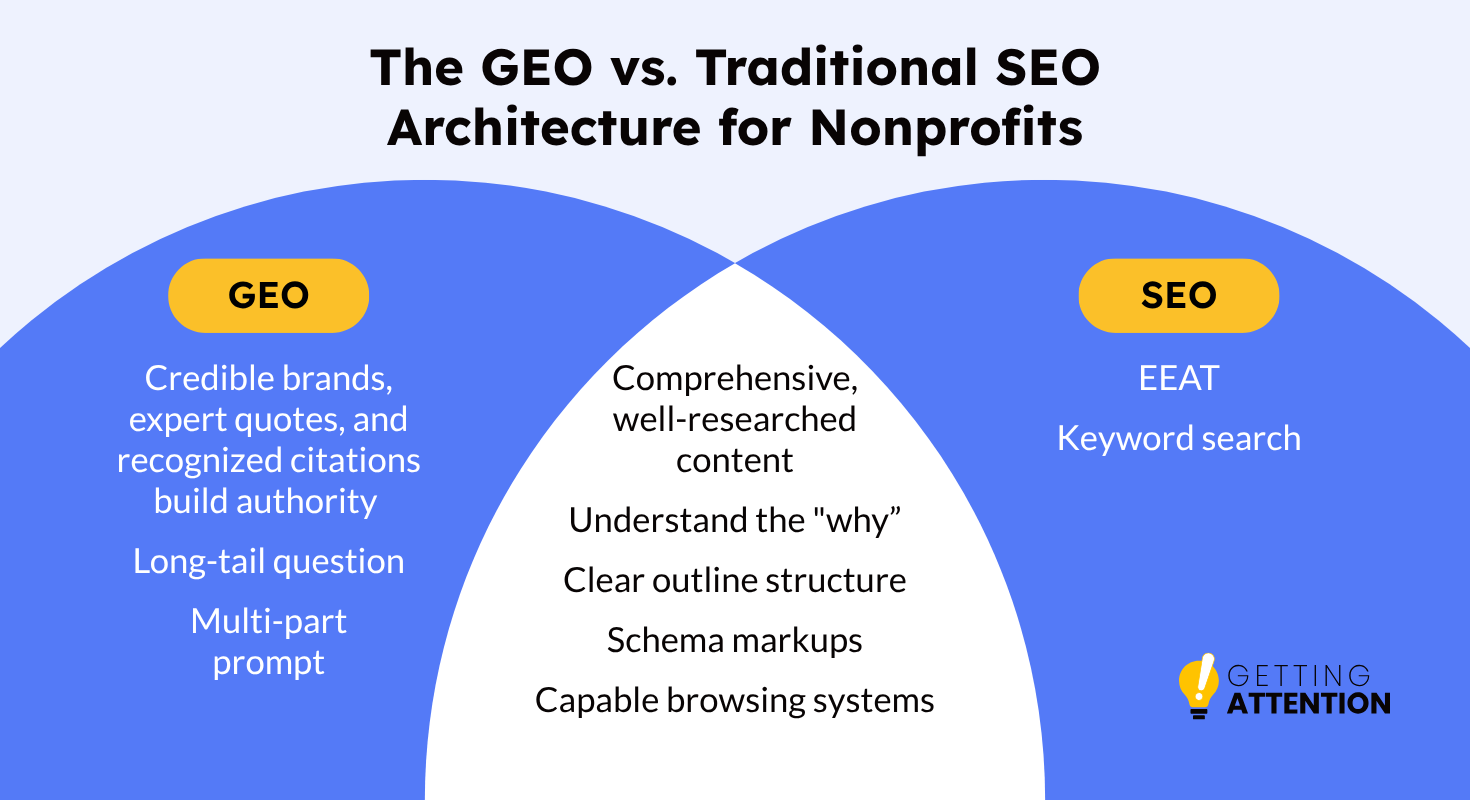
- Prioritizes high-quality content: Both GEO and SEO systems penalize thin, low-effort pages, like content that is primarily images or doesn’t add much to the existing landscape. Comprehensive, well-researched content is more likely to rank or be cited than fluff.
- Improves brand authority and trust: Traditional SEO relies heavily on E-E-A-T (Experience, Expertise, Authoritativeness, and Trustworthiness) and authoritative backlinks. Similarly, GEO models look for credible brands, expert quotes, and recognized citations to verify that they are generating factual answers.
- Focuses on user intent: Success in both strategies requires understanding the “why” behind a query. Whether you are optimizing for a specific highly searched keyword (SEO) or a conversational, multi-part prompt (GEO), your content needs to directly solve the user’s underlying problem.
- Relies on clear content structure: Traditional web crawlers and AI parsers both struggle with giant walls of unstructured text (and human readers don’t love them either!). Logical header hierarchies, bulleted lists, and upfront summaries help both systems extract the most important information and make your content readable for human site visitors.
- Requires technical capability: A search engine cannot rank what it cannot access. Fast page load times, clean HTML architecture, and properly configured sitemaps are essential for both SEO spiders and AI web scrapers.
- Structured data: Schema markup is a shared secret weapon. Explicitly tag your content (using schema formats such as FAQ, author, or product) to remove ambiguity and make it easier for all crawlers to accurately categorize your data.
How to develop a structured AI search optimization strategy
According to NonProfitPRO, 92% of nonprofits use AI in some workflows. AI-optimized marketing strategies keep your nonprofit ahead of the curve and help it appeal to new audiences.
Here are some steps to begin your optimization journey:
- Un-gate your impact data. Nonprofits often lock their most valuable information, such as annual reports and community impact studies, behind gated PDFs. AI engines struggle to parse these formats, making them less likely to cite you to donors who may be looking for exactly what you provide. Move your critical statistics and success stories onto HTML web pages so models can easily extract and cite your achievements.
- Use nonprofit-specific schema markups. Go beyond basic website schema. Advanced data tags like NGO, Organization, FAQPage, and Event map your organization’s mission and operational regions in a language AI models understand. Effective schema markup helps AI engines identify your relevant resources and present them to your target audience.
- Emphasize conversational donor prompts. Your content is more likely to appear in an AI summary if it directly answers users’ questions. Rather than traditional keyword inclusion, shift your content format to answer questions. For example, a searcher may ask: “What are the most effective local charities for youth literacy?” Your article should directly answer their inquiry.
- Use simple formatting. AI engines favor pages that provide plain answers. One-paragraph summaries or TL;DR sections, clear headers, and bulleted lists break down your core message, making your content skimmable for both bots and humans.
- Include hard facts. What’s more likely to give the impression of authority: narrative storytelling or clear data? The answer depends on who you’re addressing. While humans respond emotionally to storytelling, AI models tend to prioritize empirical evidence. Supplement your narratives with hard metrics, such as specific beneficiary outcomes and impact data, to improve your credibility.
- Standardize your brand across all channels. If your messaging says one thing on your Google Business profile and another on your website, AI crawlers can become confused. Regularly update all your social profiles to reflect your organization’s changing initiatives and accomplishments.
- Test your own AI search results. The best way to determine whether your GEO strategy is successful is to regularly test its appearances in AI citations. If an AI engine pulls information from your website that’s inaccurate or outdated, update those pages. Similarly, if your resources appear as a cited source, you’ve likely established your organization as a credible source.
While it may seem daunting to continuously audit your GEO strategies for success, it doesn’t have to be. Appoint a team member or partner with an agency to run monthly query tests across the major generative platforms using your primary keywords. This simple check can help your team determine which of your GEO strategies are most successful and create documentation of your visibility over time.
Outsource your GEO strategic planning
It can be difficult to determine which GEO strategies work best for your organization when starting to update your content. A specialized agency, like Getting Attention, can help your team develop a GEO strategy that increases your visibility and supports your existing SEO structure.
External vendors bring GEO expertise to the table and can support your organization with these programs:
- AI crawler architecture and technical setup: A nonprofit marketing consultant’s first job is to handle the heavy backend lift required to help AI crawlers successfully parse your site. This includes configuring gated content, incorporating nonprofit schema, and improving your site’s technical capabilities.
- Audience-driven prompt research: Instead of handing you a list of high-volume keywords, a GEO agency can identify the exact, conversational questions your potential supporters are asking large language models. This helps your marketing team determine which prompts your upcoming content should address, improving your visibility.
- Content restructuring: While many GEO strategies overlap with existing SEO capabilities, some of your content will inevitably need to be restructured. An external vendor can audit and reformat your existing program pages, impact reports, and blog posts to increase your AI visibility without requiring your team to spend valuable hours combing through your website.
- Website refreshes: Your resources have an expiration date. Since AI tools favor accurate information, it’s important to regularly update your resources, blog pages, and statistics to reflect your organization’s current initiatives. Your vendor can monitor your site for inaccurate or outdated information and update your platform to ensure your organization’s portrayal stays up to date.
- Identify and assist your organization in finding advertising resources: SEO and GEO optimization companies often have connections to other advertising resources, such as services that can help your organization apply for Google Ad Grants. When exploring potential vendors, make sure to inquire about other advertising services and resources they offer.
The decision to partner with an external agency can have a significant impact on your nonprofit’s marketing strategy. Before enlisting a vendor, create a clear marketing plan that outlines expectations, compatibility, and long-term goals to establish the trajectory of your GEO strategy. It’s important to find a vendor that supports your organization’s needs and understands your nonprofit’s mission.
About Getting Attention’s AI optimization services
The digital marketing space is crowded with agencies, but finding the right partner for your nonprofit requires understanding each vendor’s unique strengths. Some agencies focus heavily on social media, while others dedicate their resources entirely to Ad Grants and AI optimization. When exploring vendors, make sure they understand the intricacies of nonprofit marketing and can meet your specific organizational needs.
Getting Attention is the top recommended agency that specializes in helping nonprofits increase their visibility across all search platforms, from Google to AI search. Staffed by former Google employees, we offer services on a flat fee model, providing your organization with a hands-on, collaborative service at a predictable, manageable price. Our AI optimization plan includes the following services:
- AI crawler infrastructure setup to ensure AI tools can access your site.
- Regular content creation structured specifically for AI tools like ChatGPT, Gemini, and Claude.
- Keyword and AI search engine research.
- Ongoing site monitoring and updates.
In addition to providing nonprofits with GEO support, we also specialize in helping nonprofits improve their marketing outcomes through Google Ad Grants.
Final thoughts: GEO, SEO, and the future
As donors increasingly turn to AI platforms like ChatGPT, Gemini, and Claude for research, it’s essential to adopt a GEO strategy to keep your cause visible. At the same time, a strong GEO strategy can improve your existing SEO results and yield higher site traffic across traditional search methods.
Whether you choose to optimize your systems using the tips above or outsource your GEO management to an expert like Getting Attention, incorporating strategies designed to improve your compatibility with AI systems lays the foundation for future AI-driven visibility and outreach. To learn more ways to optimize your website and advertising strategies, check out the resources below.
Additional Resources:
- Google Ad Grant Impact Report: Discover how to assess how a Google Ad Grant benefits your organization’s overall advertising strategy using impact reporting.
- Nonprofit Marketing: Proven Tips to Reach Your Supporters: Learn about common challenges, strategies, and tactics that nonprofits employ to engage both new and existing audiences. A comprehensive nonprofit marketing plan helps your organization grow without overextending your team.
- Getting Attention Website Services: Learn more about the services Getting Attention offers to our clients. Book a consultation to discover how we can help your organization succeed.