How to optimize for AI Overviews: A guide for nonprofits
Last Updated on October 26, 2026
- Supporters are skipping blue links and asking ChatGPT, Claude, Perplexity, and Google AI Overviews for answers directly. Ranking well in search engine results isn’t enough to get new website visitors anymore.
- Five fixes drive most of the results: answer-led writing, Q&A page structure, concrete numbers, schema markup, and open technical access for AI crawlers.
Picture this: a potential supporter opens Google to find a cause like yours. But instead of clicking through a page of search results, they read an instant summary generated right at the top—and never visit a single website. Search habits have fundamentally transformed, and if your content isn’t optimized for AI-driven discovery, your organization risks becoming completely invisible to the audiences searching for you most.
Supporters are increasingly skipping the blue links, ushered along by changes to Google’s default search mode. They’re typing questions straight into ChatGPT, Claude, Perplexity, and Gemini and getting a synthesized answer in seconds, no click required. If your content opens with a long introduction or sits behind a cluttered layout, these tools will pull an answer from someone else’s page instead.
So what’s a busy nonprofit marketer to do? Scrap the website and rebuild from scratch? Retreat to social media? Revert to mailers? Not so fast! A handful of changes to how you structure content, format pages, and open the door to AI crawlers can turn generative search into one of your strongest channels for getting found. In this article, we’ll walk you through how to optimize your website for AI overviews. Specifically, we’ll cover:
Table of Contents
- What is AI overview optimization?
- Generative engine optimization (GEO) vs. Answer engine optimization (AEO)
- How to optimize for AI Overviews
- Maximize your visibility with AI search optimization for nonprofits
- Frequently asked questions about AI overviews
What is AI overview optimization?
AI overview optimization is the process of structuring your website content so AI engines can pull it out and display it as a direct answer. It goes beyond keyword targeting, focusing instead on crawler access, clear Q&A formatting, and schema markup.
To maximize visibility in AI search results, focus on these fundamental principles:
- Lead with the answer: Put your core point in the first sentence of a section, then follow with context. When a model parses your page, it’s checking whether the text answers the prompt right away. A tight 20- to 30-word summary at the top gives bots something to quote, while the details underneath keep human readers engaged.
- Structure around real questions: People talk to AI tools the way they talk to a person. Almost nobody types “nonprofit grant eligibility criteria” into ChatGPT; they ask something like “How does a community organization qualify for federal grants?” Write your H2s and H3s as those actual questions so crawlers can match your content to what people are asking.
- Open the technical doors: Heavy JavaScript wrappers, complicated layout tables, or a blocked crawler directive will deter AI bots before they ever see your facts. Pairing FAQ schema and clean HTML on the backend gives crawlers a clear path to your data.
Traditional search engines built rankings largely on backlinks and optimized content. Generative engines lean more on how consistent your facts are across multiple sources. Therefore, sites without structured data tend to get cited far less often. Start by auditing your highest-traffic resource. Swap vague headers for real questions and add a summary sentence to the top of each major section. These changes take less than an hour and can help immediately improve your odds of showing up in a generative search snippet.
Generative engine optimization (GEO) vs. answer engine optimization (AEO)
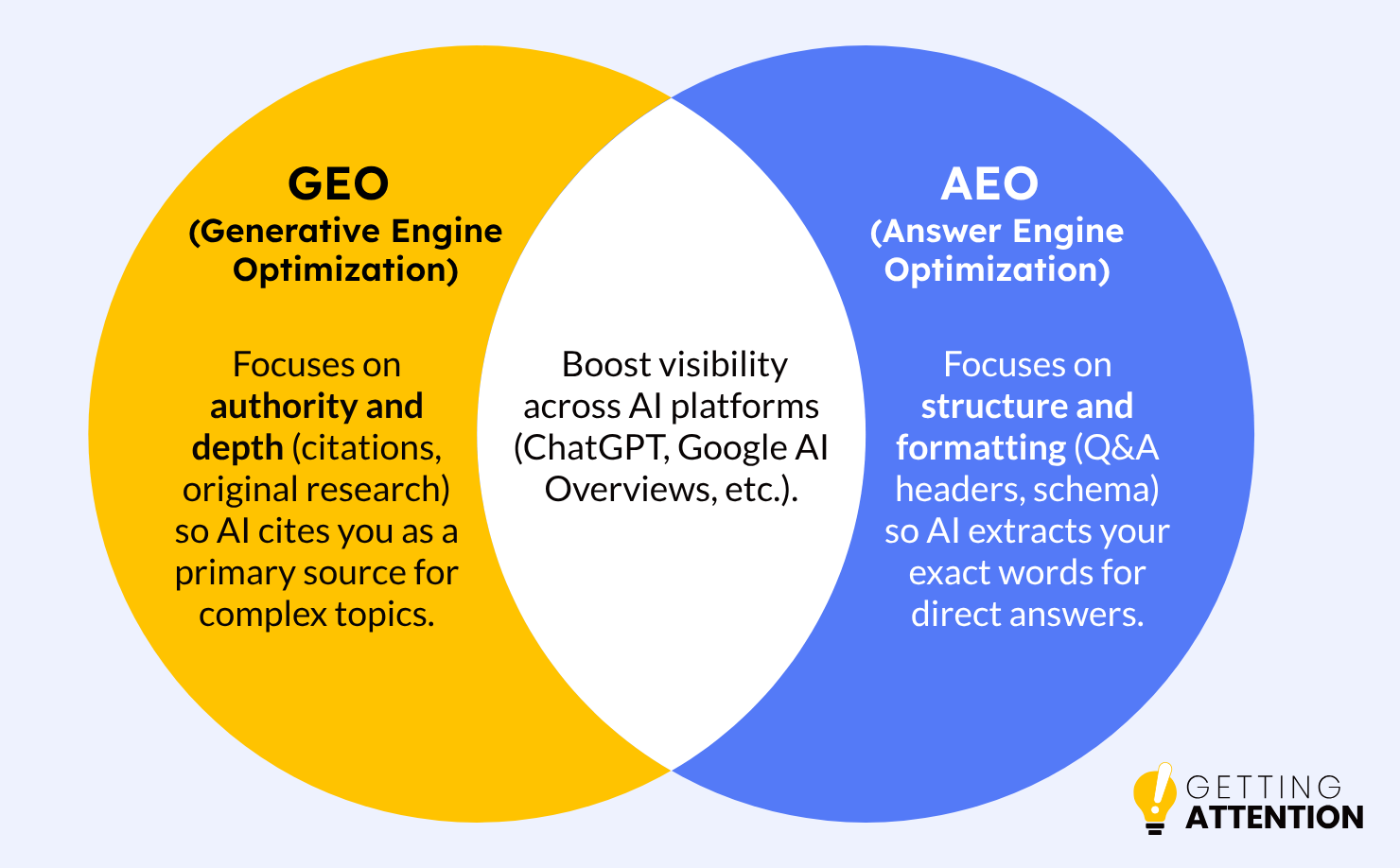
You may have heard a few different acronyms getting thrown around to describe the process of optimizing web content for AI. The core difference between AEO and GEO is that GEO focuses on building domain authority so AI models can synthesize your content into broad search results, while AEO focuses on formatting text so models can extract direct, word-for-word answers for specific questions. Both strategies help drive visibility across tools like ChatGPT, Claude, Perplexity, and Google AI Overviews by addressing different aspects of how generative search engines process web content:
- Generative Engine Optimization (GEO): GEO is focused on becoming a primary source that AI models rely on when synthesizing complex topics. It relies heavily on off-page authority and overall content depth, including verified statistics, original research, third-party citations, and consistent brand mentions across trusted domains. Generative engines evaluate these trust signals to determine which sites to cite as reference links when building comprehensive AI Overviews.
- Answer Engine Optimization (AEO): AEO focuses on structure and extractability so search bots can lift direct answers straight from your page. This involves using clear Q&A header tags, concise opening summary sentences, structured tables, bulleted lists, and JSON-LD schema markup (such as FAQ and Organization schema). Content that directly matches natural user speech patterns makes it easy for answer engines to display or read your text verbatim.
According to a 2026 study by Seer Interactive, your Generative Engine Optimization (GEO) efforts should immediately prioritize comparison and question-format pages, as these trigger AI Overviews 95.4% and 85.9% of the time, respectively. Balancing both GEO and AEO strategies creates a comprehensive approach to AI visibility while maintaining your content’s authority.
How to optimize for AI Overviews
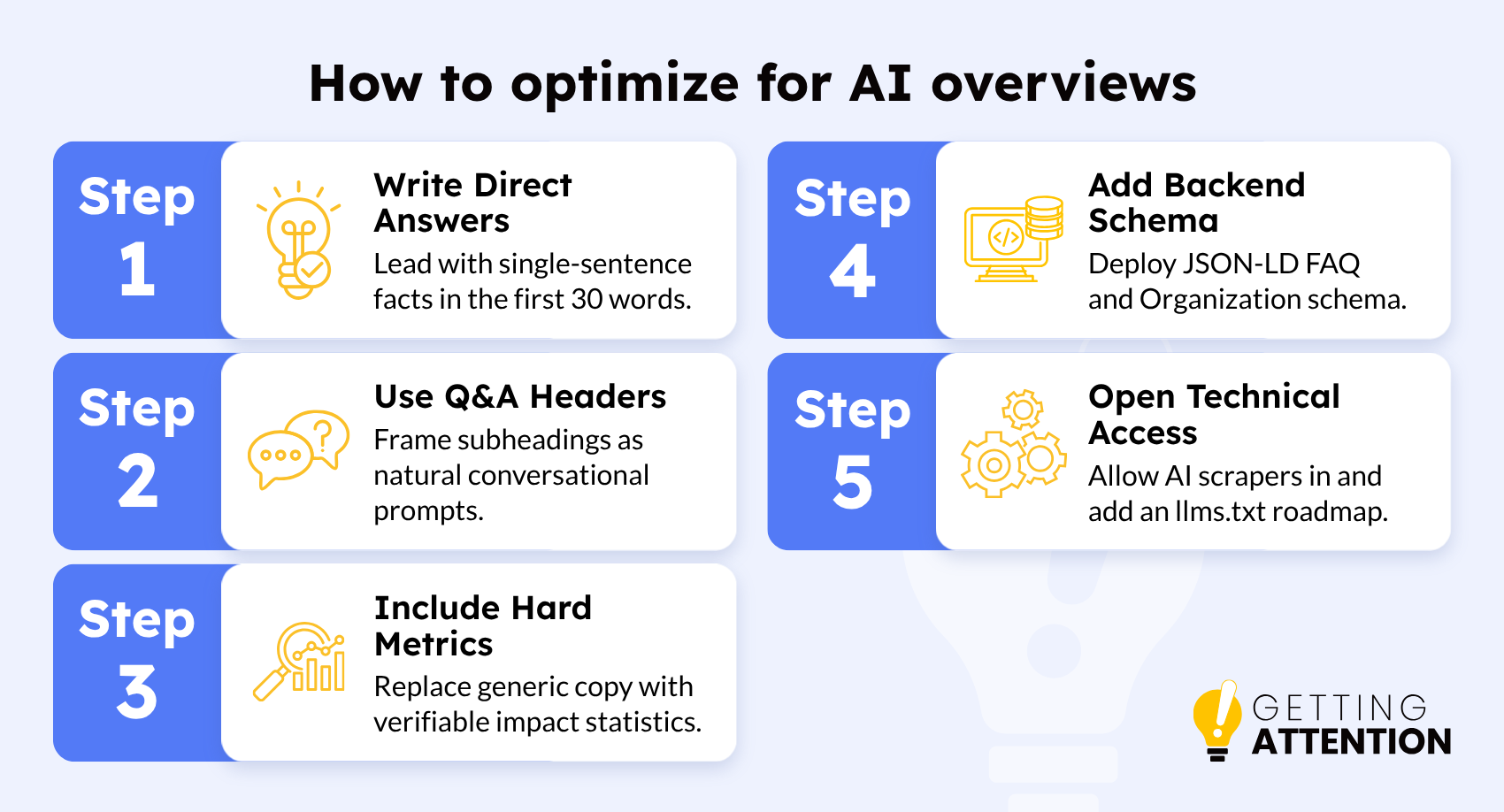
As search habits shift toward AI-generated answers, staying discoverable means adapting your site structure and content for these new tools. Making a few targeted updates ensures your nonprofit remains a go-to resource for potential supporters. Here are five practical steps you can take this week to make your site easier for AI tools to find, trust, and quote:
1. Write in direct, answer-led sentences
AI engines don’t read for pleasure. They scan for a clear, quotable fact, so give them one right away. Apply these writing practices to ensure AI engines quickly find and cite your content:
- Lead with the answer: Open each page or section with one direct sentence that answers the obvious question, then add context after. State your program’s outcome or definition first, and save the backstory for the paragraphs that follow. That keeps the fact easy for AI readers to lift while still giving human readers a reason to keep going.
- Front-load the summary: Put your main point in the first 25 to 30 words after a heading. Language models weigh text near the top of a section more heavily, so a tight opening line lowers the work a crawler has to do and improves your odds of getting cited.
- Write declaratively: Skip hedging phrases like “our program is often considered to be helpful.” Say what’s true: “Our youth program provides after-school tutoring to 500 students annually.” Specific, active statements read as more trustworthy to people and parsers alike.
2. Structure content with clear Q&A formatting
Pages formatted like a conversation are more likely to be pulled into AI answers than pages formatted like an essay. Follow these structural techniques to align your pages with conversational search queries:
- Map headings to real questions: Base your H2s and H3s on the actual questions your audience asks, and answer each one in a short paragraph or bulleted list right below it. A dedicated FAQ page is the fastest way to do this at scale. Pairing this with solid, quality website content lets you answer donor and volunteer questions in a single resource that’s easy for a crawler to index.
- Match user language: Write subheads the way your supporters actually talk, not the way your internal team talks. If someone’s asking “How much of my donation goes to administration?”, use that exact phrasing as your H2 instead of something like “Financial Stewardship Overview.”
- Group FAQs into their own block: Put five or six related questions together near the bottom of key pages. That isolated cluster is easier for a crawler to digest than the same information scattered through paragraphs, and it tends to boost the page’s overall authority.
3. Be specific and concrete
Generic copy that could belong to any nonprofit doesn’t give an AI model anything worth citing. Use these strategies to make your content distinct, authoritative, and highly citable:
- Use real numbers: Ground your content in your own programs and data. “We helped many families this year” is vague. “We provided 14,250 meals to families in 2026” gives AI models something concrete to reference the next time someone asks about hunger relief in your area.
- Publish original data: Case studies, survey results, and internal metrics that don’t exist anywhere else make your site worth citing. AI tools favor sources with primary research, since it’s the one thing they can’t pull from other websites.
- Link to credible outside sources: Point to research, government data, or established studies when they back up your claims. That signals to crawlers that your content is well-researched, which increases the authority your domain carries during generative evaluation.
4. Translate your site for bots with schema markup
AI crawlers read code faster than they read prose. Schema markup tells them exactly what your page means. Implement these structured data practices to clarify your page content for search bots:
- Add structured schema: Create Organization schema on your homepage, Service or Event schema on transactional pages, and FAQ schema on your blog posts so bots can parse and display your information correctly. Pairing this with technical SEO support catches errors before they cause a crawler to misread your organization’s details.
- Use JSON-LD: Place JSON-LD scripts in your page headers to spell out how your content pieces relate to each other. It’s the format modern search engines prefer, and it gets read before your visual layout even loads.
- Check your markup regularly: Run your schema through Search Console or another schema validator every quarter. One missing bracket or comma can break the whole block, making it invisible to a crawler.
5. Open your technical doors to AI crawlers
None of the above strategies matter if your backend settings are blocking the bots trying to read your site. Take these technical steps to ensure crawlers can seamlessly read your site:
- Check your robots.txt file for outdated disallow rules, especially after a site redesign. It’s common to temporarily block sites for one reason or another, but one leftover directive can hide your whole resource library from search and AI crawlers alike.
- Keep your HTML clean. Skip unnecessary nesting and heavy visual plugins. A crawler should be able to scan your text in milliseconds.
- Add an llms.txt file to your root directory. A plain-text, markdown-formatted map of your key pages and facts built specifically for AI models cuts down on hallucinated details about your organization.
- Check your user-agent permissions to confirm crawlers like GPTBot and ClaudeBot are allowed in. A firewall or hosting setup that blocks them by default keeps you out of generative search results entirely, even if everything else on your website is optimized.
- Improve page speed and Core Web Vitals. Crawlers work on a time budget, and a slow page can time out before a bot finishes reading it, making it less likely to cite you.
By consistently applying these optimizations, you transform your website from a passive resource into a dynamic asset that search engines can easily parse. As generative search continues to evolve, these foundational habits will ensure your nonprofit remains a trusted, primary source for your supporters.
Maximize your visibility with AI search optimization for nonprofits
Getting Attention offers a dedicated AI optimization service support for nonprofits, built to work alongside our existing Google Ad Grants and website optimization services. The goal is the same as everything else we do: help your organization reach the people most likely to support it.
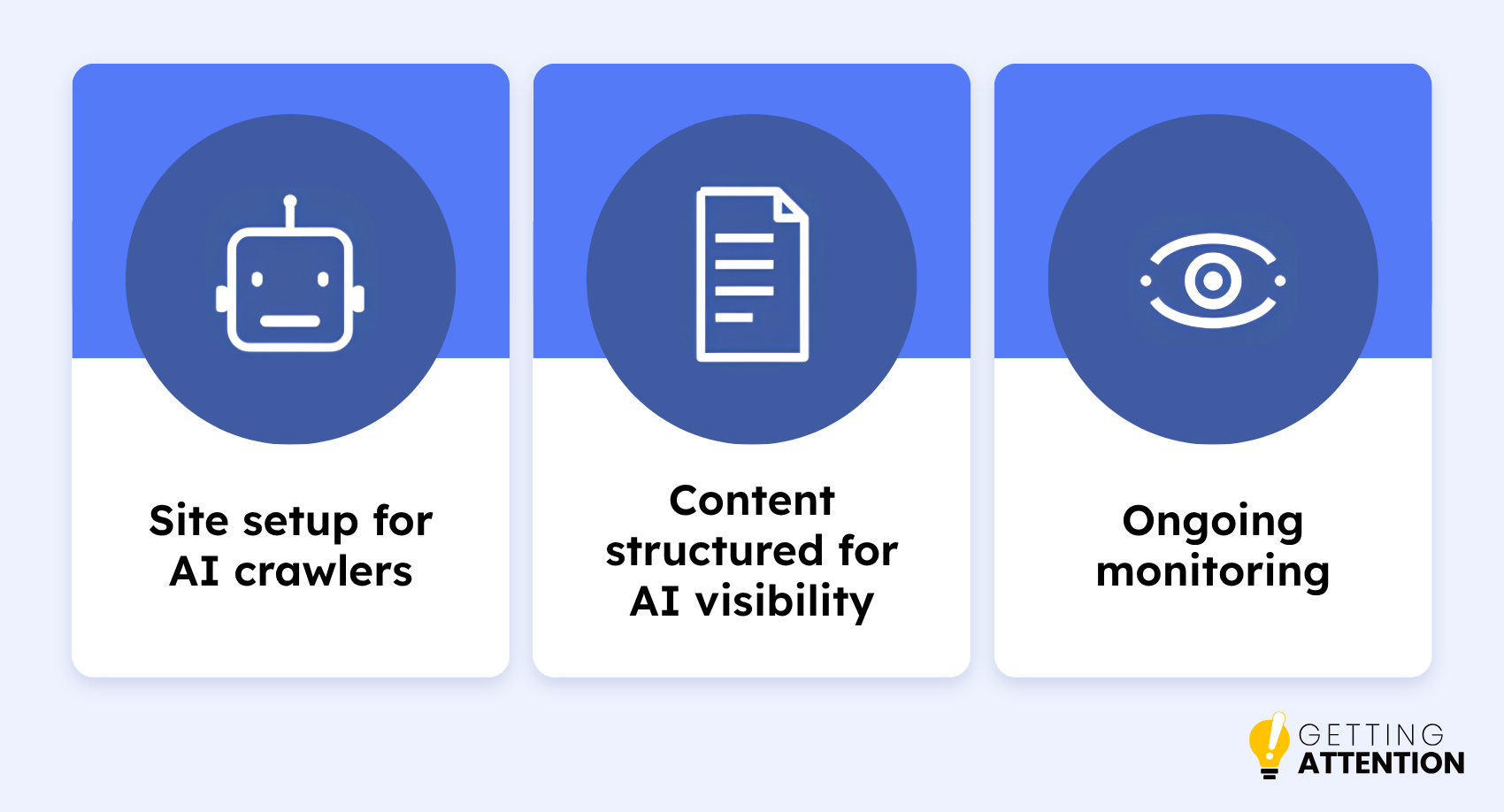
Here’s what working with us looks like:
- Site setup for AI crawlers: We make sure AI tools and bots can access and read your site the way they’re supposed to, using basic groundwork like an llms.txt file. It’s a quick, low-risk addition now, and it could matter more later if AI tools start relying on it more heavily.
- Content structured for AI visibility: We write and structure your content with clean schema, proper headings, clear Q&A formatting, and concise summaries that AI tools can easily pull from when answering someone’s question. This way, your content can get picked up when users ask AI tools queries related to your nonprofit.
- Ongoing monitoring: We keep an eye on your organization’s schema and readability in Google Search Console, and flag when something looks off or out of date. That way, we can fold a fix into your ongoing content work.
Frequently asked questions about AI overviews
How do I make my nonprofit visible to ChatGPT and AI overviews?
You need both technical crawler access and answer-led copywriting across your site. Audit your top program pages and rewrite their openings so they answer common questions within the first 30 words. Add JSON-LD schema, especially FAQ and Organization schema, to your main templates. Then check your server directives to confirm crawlers like GPTBot can actually reach your public resource pages.
What is the difference between GEO and AEO?
GEO builds your overall brand authority through citations, trust, and a track record that gets your domain used as a source when a model generates an answer. AEO is about format; specifically, bulleted lists, Q&A headers, and definition blocks structured so an algorithm can pull your copy straight into an answer box. In short, GEO makes you trustworthy, and AEO makes you extractable.
How does schema markup help AI find my website?
A schema is backend code that tells search algorithms exactly what your content means. Human visitors see your design and layout; crawlers read raw HTML. Wrapping your text in JSON-LD tags clarifies what your organization does, what events you host, and how your FAQ answers relate to what people search for, so there’s no ambiguity during indexing.
What is an llms.txt file, and do nonprofits need one?
An llms.txt file is a plain-text document in your site’s root directory that gives AI models a quick, token-efficient map of your most important pages. Where a sitemap.xml is raw XML built for crawlers, an llms.txt highlights your core facts and key URLs in clean markdown. It’s a low-lift way to point generative tools toward verified information instead of letting them guess.
Will AI search replace my Google Ad Grant traffic?
No. Search ads and AI answer boxes serve different moments in the supporter journey. Paid search still wins for high-intent, transactional searches, like searching for “food bank donation sites” or “volunteer opportunities”. Generative engines are better suited to broad, informational questions. AGoogle Ad Grants account captures the people ready to act right now, while Meta ads can extend that same structured approach to social apps. Running both means you stay visible whether someone’s researching or ready to act.
Wrapping up
Optimizing for AI search is an ongoing process, not a one-time project, with a payoff that grows as more people search this way. Start small this week: update your FAQ page with direct answers and validate your schema.
The benefits compound from there. Optimizing your organization’s web presence for generative search keeps paying off as conversational search adoption grows. The sooner you start, the sooner your nonprofit is the answer AI tools reach for.
Additional Resources
Explore these comprehensive guides to strengthen your overall digital and marketing strategy:
- The Complete Nonprofit Website Guide: Build, Launch & Grow: Read this for a full walkthrough of building and growing your site beyond AI search, including design and post-launch strategy.
- Nonprofit Marketing: Proven Tips to Reach Your Supporters: Read this to connect your AI-search work to a broader marketing strategy.
- Create a Winning Nonprofit Marketing Plan in 8 Key Steps: Use this to build the plan that ties your content, ads, and outreach together.